






true peace is not merely the absence of tension; it is the presence of justice. -Dr. Martin Luther King, Jr.
about us contact us admissions graduate degreee program center for research & practice faculty resources

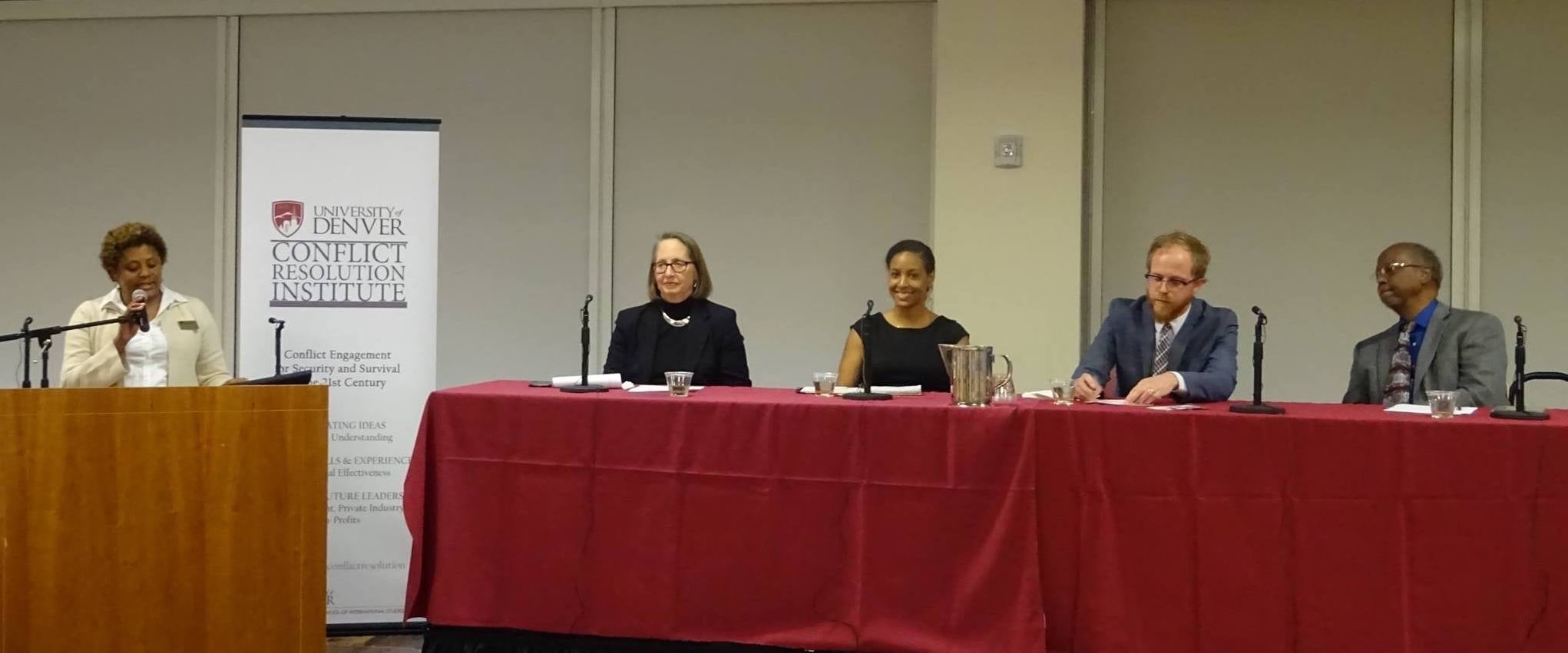
On Friday morning, September 25, more than 300 people filled the Driscoll Ballroom on the University campus for an informal discussion with 1997 Nobel Peace Prize Laureate, Jody Williams. The 90 minute session, guided by questions posed by four student panelists—all of them M.A. candidates—was moderated by Karen Feste, director of the Conflict Resolution Institute Graduate Program.

Topics under discussion ranged from international peace-building to civil society; from causes of terrorism and revolution, to domestic violence. Ms. Williams' sharp, clear responses provided not only rich commentary but often, specific recommendations for individual actions. She believes strongly that grassroots movement and public campaigns are important to changing policies and bringing peace.


Babikir Babikir opened the discussion with the subject of anti-Arab sentiments that have swept the U.S. post-911 and then asked:“if you were Dr. Condoleezza Rice, would you be willing to head a team to negotiate with al Qaeda?" Noticeably surprised by this question, Ms. Williams replied that yes, she would most definitely attempt to negotiate with the terrorist group, and went on to highlight the role that negotiation plays in the resolution of conflict and terrorism.

Mikaela Ladwig-Williams, a second-year master’s student and president of the Conflict Resolution Graduate Student Association, asked Ms. Williams about the role of the United Nations in maintaining international peace and security. Given the UN's lack of funding, global support, and political cohesion, and thus the uncertainty of its future impact, she wanted to know specifically what role the UN should have in our international peace-making efforts and what steps and/or changes are necessary to strengthen the organization.


Student Panelists with Nobel Laureate Jody Williams: (from left) Babikir Babikir, Mikaela Ladwig-Williams, Jody Williams, Adam Christopher, and Tammy Rubenstein.

First recognizing the importance and potential of the United Nations, Jody Williams responded that many of the UN’s serious flaws stem from its origins as a post-World War II creation of the self-proclaimed victors. She asserted that so long as the members of the Security Council, especially the United States, have veto power and general control of UN decisions and forces, it will remain plagued by politics. She noted, in addition, the gross under-representation of women in the UN as symptomatic of its structural flaws.

Tammy Rubenstein's questions pursued the issue of gender equality on a community level, asking about the mission of the recently established Nobel Woman’s Initiative to improve global justice. What major problems does the group confront with various cultures' beliefs about gender and equality? The Nobel Laureate’s response emphasized the importance of sensitizing movements for change to local cultural conditions in order to pursue appropriate, realistic programs for improving equality for women. She believes strongly that progress is possible, but needs to be calibrated and understood within a cultural context. Projecting an optimistic outlook, she said that careful planning and appropriate action will help individual countries in the transition process.


Adam Christopher took the discussion in another direction, raising a philosophical point about transitioning societies.“The specter of revolution and terrorism alike have plagued civil societies for generations,” he said, adding that the United States itself has a rich tradition of political and social upheaval, and that its national identity even idolizes the revolutionary in some ways. “With political revolt being not only a core value, but as Thomas Jefferson said, a duty of the American citizen, how does that fit in with your conception of peaceful civil society?”

Ms. Williams reminded the audience that revolution need not necessitate violence. She noted that there are many examples of political revolution that have been carried out peacefully, one primary example being the movement led by Gandhi.


During the final 30 minutes, Ms. Williams engaged audience members by addressing their questions, telling personal stories that led her to the Nobel Peace Prize award, and urging everyone to take action to bring about change. The audience was undoubtedly energized; and at the end, she received a standing ovation.

Return to top