







4D Co-Curricular Education with An Edge
At the University of Denver, we do co-curricular education for students differently. We design unique opportunities for you to creatively and critically engage with topical issues that develop your whole self, framed through a media and pop culture lens.
These opportunities help you prepare for life outside the classroom, building skills such as navigating ambiguity, cultivating empathy, and critically engaging with media and technology.
Browse our library of zine workbooks to develop your sense of character, intellect, well-being, and purpose in line with our Four-Dimensional (4D) Experience and in pursuit of the public good.
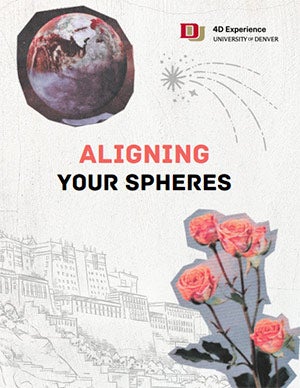
Aligning Your Spheres
Character | Well-Being
This short workbook helps you take a breath, reflect on the causes you truly care about, and identify small actions you can take to make meaningful social change in your community.
On a scale of 1 to 10, how anxious have you felt in the past year? What do you think has been contributing to your sense of anxiety—political crises, climate change, increasing workload, social media? This short workbook helps you take a breath, reflect on the causes you truly care about, and identify small actions you can take in your campus and local community to get grounded and stay engaged in the issues without burning out.
Additional Resources
- Helping Youth Move from Climate Anxiety to Climate Action. APA (2025).
- Lili Reinhart: You Are Strong. Jay Shetty Podcast (2022).
- Oprah & Richard Rohr on Finding Hope in Uncertain Times. The Oprah Podcast (2025).
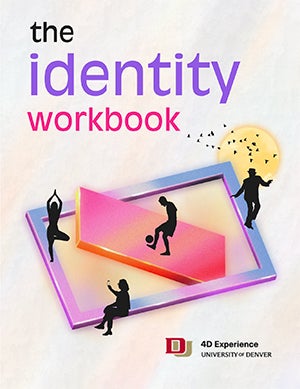
The Identity Workbook
Character | Purpose
This workbook helps you map your personal identities, social identities, and lived experiences, and reflect on how they converge to create the unique, multifaceted individual you are.
Who are you, really? Most of us think we know who we are until a crisis happens, shaking our belief systems and calling us to find new ways to navigate complex problems. While seemingly innocuous, identity shapes and colors everything we think, say, do, and experience—especially in college as we learn and engage with individuals who think, live, and lead differently from us. This workbook helps you map your personal identities, social identities, and lived experiences, and reflect on how they converge to create the unique, multifaceted individual you are. Getting clear on who you are is the first step in choosing a career that feels meaningful to you, building authentic friendships and relationships that will last, and making your personal contribution to social change and the public good.
Additional Resources
- My Identity Is a Superpower. America Ferrera, TED (2019).
- Identity Crisis: Why Defining Yourself by Your Career Is a Problem. Harvard Business Review (2024).
- The Urgency of Intersectionality - Kimberlé Crenshaw. TED (2016).
- Beyoncé Just Got the Best Revenge in Music History. The Groove (2025).
- Why Your Identity Is an Illusion. Eckhart Tolle (2025).
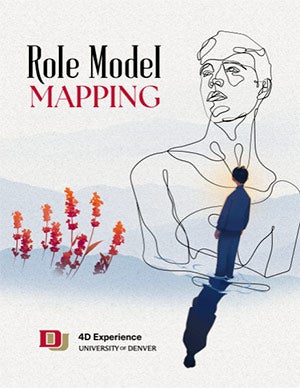
Role Model Mapping
Intellect | Character | Well-Being | Purpose
This workbook helps you reflect on the people who have shaped your values, choices, and sense of possibility, and intentionally cultivate relationships to achieve your fullest potential.
Who do you want to be when you grow up? We were all asked this question as children, and the reality is most of us are still figuring it out. Higher education can be a crossroads, full of uncertainty and exploration, as students carefully weigh decisions about career, purpose, and relationships that will impact the trajectory of your life. The path you follow is often influenced, consciously and subconsciously, by those you take cues from—in real life, and in media. This workbook helps you reflect on the people who have shaped your values, choices, and sense of possibility. By mapping your role models and mentors across the four dimensions, you can begin to recognize patterns, expand your network to include new perspectives, and intentionally cultivate relationships that help you achieve your fullest potential.
Additional Resources
- Crimson Constellation
- Career & Professional Development
- Office of Academic Advising
- Health & Counseling Center
- DUhelp
- The Science of Mentorship Podcast (2021)
- The Role of Role Models - Neil deGrasse Tyson National Geographic (2016)
- Adele’s Reunion w/ Teacher Has Her in TEARS. Access Hollywood (2021)
- Naomi Osaka & Coco Gauff. US Open Tennis Championships (2019)
- Dead Poets Society (1989)
- Hidden Figures (2016)
- Creed (2015).
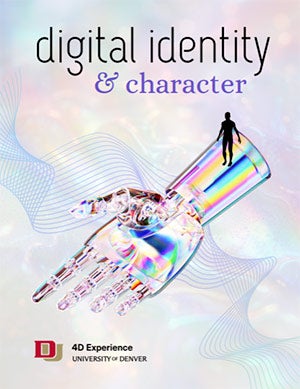
Digital Identity & Character
Character | Purpose
This workbook invites you to reflect on the core aspects that make up your identity and character, online and offline, and consider ways to align your digital story with who you are becoming.
In the digital age, the lines between real and virtual life are becoming increasingly blurred. Students are experiencing more anxiety and stress related to social media, digital self-presentation, and online curation, with real-life implications for job opportunities, relationships, community service, and social impact. This workbook invites you to reflect on the core aspects that make up your identity and character as well as challenges you to audit your social media accounts to determine how well they align with who you present in real life. By actively considering your digital story, you can take steps to create more clarity and consistency across your online and offline selves, ensuring you leave behind a digital legacy of which you feel proud.
Additional Resources
- Can Social Media Activism Actually Work? PBS Voices (2024)
- Ms. Rachel On Her Family and Embracing Children Across Borders. Glamour (2025)
- You're Not Mysterious, You're Just Scared To Post Online. imuRgency (2025)
- The Matrix (1999)
- Here’s Why ‘The Matrix’ Is More Relevant Than Ever. The New York Times (2024)
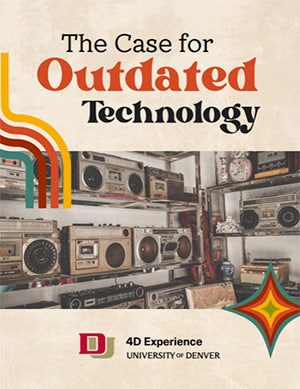
The Case for Outdated Technology
Intellect | Character | Well-Being | Purpose
This workbook invites you to reflect on the benefits of preserving and reusing outdated technology, and how “going analog” can help you slow down and reduce your ecological footprint.
In the age of AI, we are constantly inundated with new technology as employers and organizations seek to optimize performance. But what happens when we take a second to slow down and appreciate the technologies that shaped our childhood and early years, before they end up in a landfill somewhere? This workbook invites you to reflect on the utility of preserving and maintaining outdated technology, including nostalgia and mental health benefits, social connection and belonging, and ecological impacts. As college life becomes more hectic, “going analog” can help students cultivate presence, do less with more care, reduce your ecological footprint, and ensure your consumption and engagement with technology reflect your values toward others and the planet.
Additional Resources
- Technology Over Time. PBS Learning Media
- RETROSPEKT
- Low-tech Magazine
- Analogue Technology Can Be Frustrating - Is That Part of The Appeal? BCC (2024)
- I'm Raising My Kids on '90s and Retro-style Tech. Business Insider (2026)
- Bad Bunny’s DTMF Explained: The Album Fighting for Puerto Rico. Afrodizjha (2025)
- Wreck-It Ralph (2012)
- Mad Max: Fury Road (2015).
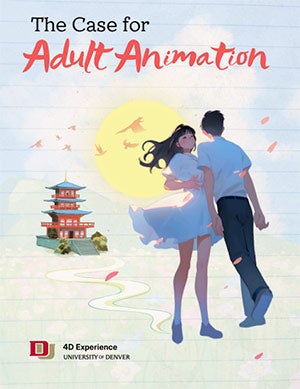
The Case for Adult Animation
Intellect | Character | Well-Being | Purpose
This workbook invites you to reframe animation as a powerful medium for everyone, and consider the intellectual, social, creative, and emotional benefits of this precious art form in the age of AI.
Despite western beliefs, animation isn’t just for children—it can be a powerful medium for adults to process emotions, practice critical thinking, build community, and explore innovation. Recent decades have seen an explosion in award-winning animated content across genres and demographics, proving that adult animation is so much more than satirical comedies and represents a new frontier of modern storytelling. For college students, engaging with animated content can provide much-needed stress relief, exposure to other cultures and ways of being, insight into how systems perpetuate inequalities, and appreciation for art and human creativity in the age of AI. This workbook invites students to consider how animation can help them think outside the box, go against the grain as they chart a purposeful life, and create, live, and lead in authentic and transformative ways.
Additional Resources
- Snow Bear (2025)
- The Wedding Veil of the Proud Princess (2025)
- Inside the Animation: Jibaro (2022)
- How Stop-Motion Movies Are Animated At The Studio Behind 'Missing Link' (2019)
- The Secret Behind Studio Ghibli’s Success — And Why It’s So Hard to Replicate. StudioBinder (2025)
- Flow (2024)
- Animation Addicts Podcast (2026)
- The Bancroft Brothers Animation Podcast (2026)
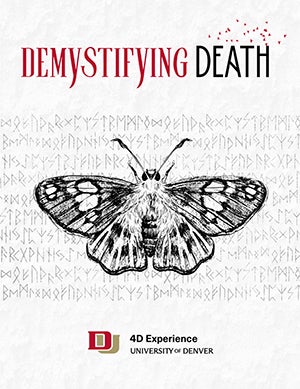
Demystifying Death
Intellect | Character | Well-Being | Purpose
This workbook invites you to engage compassionately, courageously, and critically with the realities of mortality, actively considering the kind of life you want to look back on and ways to align those values with your choices today.
What happens when we die? For most of us, the thought of death conjures up visceral feelings of discomfort, anxiety, confusion, and profound sadness within us. Why do we live in a society that is so averse to confronting and talking about death, life’s most universal transition? This workbook invites college students to engage compassionately, courageously, and critically with the realities of mortality, actively considering the kind of life you want to look back on and finding ways to align those values with your choices today. Exploring death positivity can help you get grounded, stay present in times of change, grieve in healthy ways, consider your own end-of-life plans and their ecological impact, recognize inequalities in social health, and advocate in your community to ensure a good quality of life, and a good quality of death, for all.
Additional Resources
- DU Health & Counseling Center
- DU Student Outreach & Support
- The Conversation Project
- Death Over Dinner
- The Order of the Good Death
- Andrew Garfield and Elmo Explain Grief. Sesame Workshop (2024)
- Megan Thee Stallion: The Traumazine Interview. Apple Music (2022)
- If You Are Experiencing GRIEF Today, This Episode is For You. Jay Shetty Podcast (2025)
- Living With the Dead in Indonesia. BBC News (2017)
- Eternity (2025)
- The Good Place (2016)
- Last Meals Podcast (2026)
- What Really Matters at the End of Life - BJ Miller. TED (2015)
- The Corpses That Changed My Life - Caitlin Doughty. TEDx (2016)
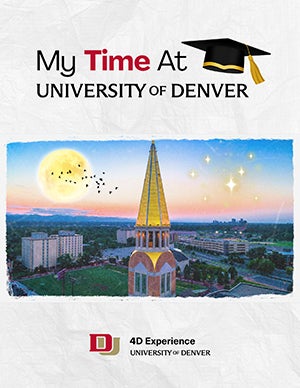
My Time at DU
Intellect | Character | Well-Being | Purpose
Are you graduating from DU? Who were you when you first began your journey here, and who are you are now? Graduation can be a complex and emotional time, full of joy and sadness as you begin to let go of your college era and look towards your next chapter.
This workbook helps you pause, reflect, and honor the people and experiences that brought you to this moment, consider your transformational growth across the four dimensions, and craft practical and powerful stories to take with you into your next opportunity. It also includes activities for designing your own college collage, space for friends and mentors to leave you notes, and exercises to write letters to those you shaped you along the way and to the future self you envision.