







Mentoring

The University of Denver offers comprehensive Faculty Mentoring Programs aimed at supporting the professional development of faculty across ranks and series. These mentoring programs are designed to enhance faculty success and foster a supportive academic environment. By participating, faculty members can gain valuable insights, develop new skills, and contribute to a culture of continuous learning and mutual support.

Explore the programs to see how you can benefit from the resources and opportunities available through the Mentoring Programs at the University of Denver.

This page covers:

Mentoring Models

This section provides specific examples of mentoring activities that already take place at DU. It also includes ideas cultivated from the literature and other institutions that could provide platforms for developing mentoring activities that fit current faculty needs.

A variety of mentoring models exist (Figure 1) and they range in both structure and duration. For example, “Micro-mentoring” activities could include single, topical meetings or an “On call” model (Slack or Teams). This approach is highly useful for connecting new faculty to resources. Peer on Peer Circles – POP circles – are often longer in duration but contain less structure so they can evolve with faculty needs. Cross-identity mentoring might take place in any of these mentorship models; it is particularly important to consider mentor training for mentors in this context.
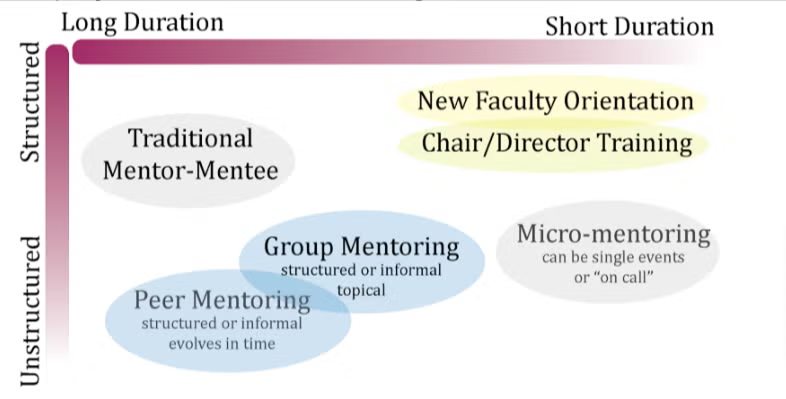
Figure 1: Types of mentoring and the time and structure involved.  Mentoring networks often encompass multiple modes of mentoring and multiple models for mentees to achieve their career goals. Affinity groups and cross-identity support is often incorporated into all models of mentoring.  Highlighting indicates the type of initiative; Yellow initiatives are for new faculty and blue initiatives are topical (i.e. chair support, teaching) or built around affinity groups.
Figure 1: Types of mentoring and the time and structure involved. Mentoring networks often encompass multiple modes of mentoring and multiple models for mentees to achieve their career goals. Affinity groups and cross-identity support is often incorporated into all models of mentoring. Highlighting indicates the type of initiative; Yellow initiatives are for new faculty and blue initiatives are topical (i.e. chair support, teaching) or built around affinity groups. Figure adapted from The University of Washington’s Mentoring Toolkit

Existing Faculty Mentoring Programs/Initiatives at DU

Mentoring programs and models vary across the University of Denver to support the diversity in faculty lines and needs. For new faculty, the most common models include a traditional dyad (mentor/mentee pairing) and/or a small group cohort.   Below you will find lists of current DU mentoring programs. While DU has a variety of different mentoring programs, they are not currently actively administered or aligned across units.  It is important to remember that while mentoring programs are helpful and essential to faculty well-being, they are also not an answer to all university issues.

University Wide Mentoring Programs

Department/Unit Led Mentoring Programs

  • College of Arts, Humanities, and Social Sciences

    The CAHSS new faculty mentoring program is a one-year, opt-in program, in which we pair each interested incoming faculty member with a senior faculty member in another department/program. Mentors offer a cross-CAHSS social connection and can provide guidance and information about working at DU, scholarship or teaching, or whatever other questions you might have, meeting approximately once per quarter.

    CAHSS new faculty mentees can expect to participate in the following:

    • ·a kick-off individual mentor-mentee meeting in late September or early October, to identify specific concerns, areas of interest, and goals that the mentor can help the mentee work toward over the course of the academic year
    • an in-person check-in meeting with their mentee at least once per quarter, to discuss progress toward goals and troubleshoot any issues or questions
    • In addition, mentees are expected to attend at least two CAHSS professional development events during the year. For example, this fall we have an Inclusive Teaching workshop on creating equitable grading rubrics, and an overview of the DU CARE Team and how it supports students.

    Program overview:

    CAHSS offers a year-long mentoring program for new faculty in which we pair incoming teaching/clinical/of the practice and tenure line faculty members with a mentor who is an associate or full teaching- or tenure-line faculty member in another department/program.

    For mentees, the program’s goals are:

    • Provide guidance toward promotion and tenure
    • Provide support in strengthening teaching
    • Provide support for research and writing and/or creative work productivity
    • Provide support in navigating service
    • Provide support for BIPOC and other minoritized faculty members
    • Support an overall sense of College belonging

    For mentors, the program’s goals are:

    • build your own skillset, including further developing leadership and interpersonal skills
    • build relationships with colleagues from different fields and career stages
    • support your own career progression by broadening your service portfolio.

    Mentors are expected to participate in a training session, and mentor-mentee pairs are expected to meet for a 60-90 minute kick-off and goal setting meeting, followed by quarterly in-person check-in meetings and communication by email or other means as appropriate.

    For more information, contact Andrea Stanton, Senior Associate Dean of CAHSS.

  • Daniels College of Business

    Faculty Served: Two programs: 
    1) New Appointed Faculty, 
    2) All Appointed Faculty

    Approach: 
    1) New Faculty Orientation: University resources, Promotion Review Process, Policies and Processes (e.g., IT, Annual Merit Review) and introduction to Daniels graduate and undergraduate programs.

    2) Yearly separate Zoom sessions with Associate Dean and representatives from Daniels Tenure Track and Teaching and Professional Promotion/Review Committees to discuss the review process

    For more information, contact Kellie Keeling, Chair and Associate Professor for the Daniels College of Business Department of Business Information and Analytics

  • Graduate School of Social Work

    Faculty Served: All appointed faculty
    Approach: Individual mentoring for newly hired faculty as well as for faculty as needed.  

    For more information, contact Ramona Beltran, Associate Dean for Research and Faculty Development 

  • Morgridge College of Education

    Faculty Served: all newly appointed faculty (Years 1-3) 

    Approach: Mentoring program for new MCE faculty. Dyad model with a senior faculty and the new faculty member, built around mentee’s mentoring plan. The expectations are one dyad meeting per quarter. In addition to dyads, there are additional quarterly sessions for professional development.  

    For more information, contactLaura Sponsler, Interim Associate Dean for Faculty Affairs 

  • NSM Teaching Group

    Faculty Served: All faculty
    Approach: Not mentoring, per se, but a group that collaborates on teaching practices.

    For more information, contact Nic Ormes, NSM Associate Dean. 

  • University Libraries

    Faculty Served: Assistant Professors

    Approach
    1) New assistant/visiting assistant professors are formally paired with a professor that has attained promotion. 
    2) Monthly group mentoring meetings.  
    3) Onboarding committee for new assistant professors.

    For more information, contact Bridget Farrell, Associate Professor and Coordinator of Library Instruction and Reference Services University Libraries. 

  • STEM Women’s Faculty Association

    Faculty Served: All Faculty 

    Approach: Monthly meetings in person/on zoom. Topics addressed are quite organic – usually center on university/college level issues. 

    For more information, view DU’s Women’s Coalition website or contact Anna Sher. 

Frequently Asked Questions

  • What kind of mentor do I need?

    This resource from Duke University’s graduate school describes the many roles a mentor may play (advisers, tutors, sponsors, supporters, experts, role models) and provides examples of what each of those roles might “look like” when applied. For example, a faculty member may want to: 1) connect with a mentor within their department to understand promotion expectations and procedures, 2) seek mentorship on teaching or research from those that may or may not reside in the same department (or institution), 3) seek a mentor that can help navigate cross-identities and challenges, 4) identify a mentor that is a colleague experiencing the same situation (peer-mentor).

  • What is a departmental mentoring plan?

    Mentoring plans help departments or units to articulate how faculty will receive the mentoring and support they will need to be successful in their new or continuing roles. This mentoring plan from the University of Massachusetts Amherst helps mentoring teams to tailor plans to each new hire.

  • Are there practical solutions for match-making mentor-mentee pairings?

    It helps if the mentee has clear goals for what they want or need in a mentor. Afterwards, a conversation with a chair, dean, or colleague could help identify new mentors that would fit at the university. For example, this could include identifying a mentor in the same line (e.g. teaching, tenure, etc) or with a certain skill (e.g. successful at receiving funding from the NSF) or an affinity group.

  • I don’t have time to do this in person. Are there virtual options?

    Virtual mentoring or E-Mentoring build relationships through online media. The mentoring may take place entirely through electronic communication or could be developed in person and then move to an online format. Some online services in this area exist already, like MentorNet (http://mentornet.net), which is a free resource for women in Engineering and Science that matches students, post-docs, and early-career researchers across universities and within industry. 

  • How do I motivate faculty to participate as mentors?
    1.  Acknowledge and reward mentorship within the typical research, service, teaching review categories during merit reviews.
    2. Provide funding to support mentoring (e.g. for mentor/mentee to have lunch/coffee).
    3. Recognize mentors in promotion/reappointment to show that mentorship is valued. 
    4. At DU, CAHSS provides faculty mentors with a stipend.
    5. Remember to not  over-burden certain identity groups as mentors.
  • Why should I be a mentor? What’s in it for me?

    Mentoring improves job satisfaction and can build valued relationships. It can help you understand what your colleagues need and help them be successful and stay at DU. This could mean that you have one less search committee in the future. It also is a service activity that can be added to Workload Equity dashboards, if they exist in your unit, and in annual evaluations.

  • I’ve noticed that faculty in my unit need advice on certain, sometimes detailed, topics. How can I handle that?

    Psychology has a skill matching program for graduate students that might be a good model for faculty as well. Graduate students volunteer their expertise and all new students receive a list of topics they might need mentorship or other help around with contact information for potential topical mentors. 

  • How do I know if I need a mentor? What kind of mentoring do I need?

    Pairing can happen by identifying what you are specifically in need of. See the GSSW program for useful structures. After identifying needs, a chair, director or colleague could help identify good mentors. The Writing Program uses small group mentor cohorts, which takes some pressure off dyad pairings and adds more voices to the mix.

  • What training do I need to be a mentor?

    There are numerous resources available to help train mentors in core mentoring skills. This document from North Carolina State University provides some fantastic resources to start mentor training in your unit. There is also training available online, for instance, through NCFDD and CIMER, and mentoring training is being developed in various units at DU (for instance, through the MERISTEM ADVANCE grant programming, through the VPFA’s Mentoring community of practice, and in the Writing Program). 

  • I don’t have much time, but I want to help. What should I do?

    Consider getting coffee with a new colleague to check-in or participating in any micro-mentoring or online mentoring opportunities in your college or unit.

Helpful References

National Center for Faculty Development and Diversity:

DU faculty can access an individual membership at the National Center for Faculty Development & Diversity (NCFDD) by registering for an account using their DU email address. DU has an institutional membership that makes this possible. The NCFDD offers resources, events, and webinars that foster faculty development and success in areas like research, teaching, and time management (https://www.facultydiversity.org/).