Current Students
Written by Lexi Schlosser, Faculty Developer of Online Learning and Becca Ciancanelli, Director of Inclusive Teaching Practices
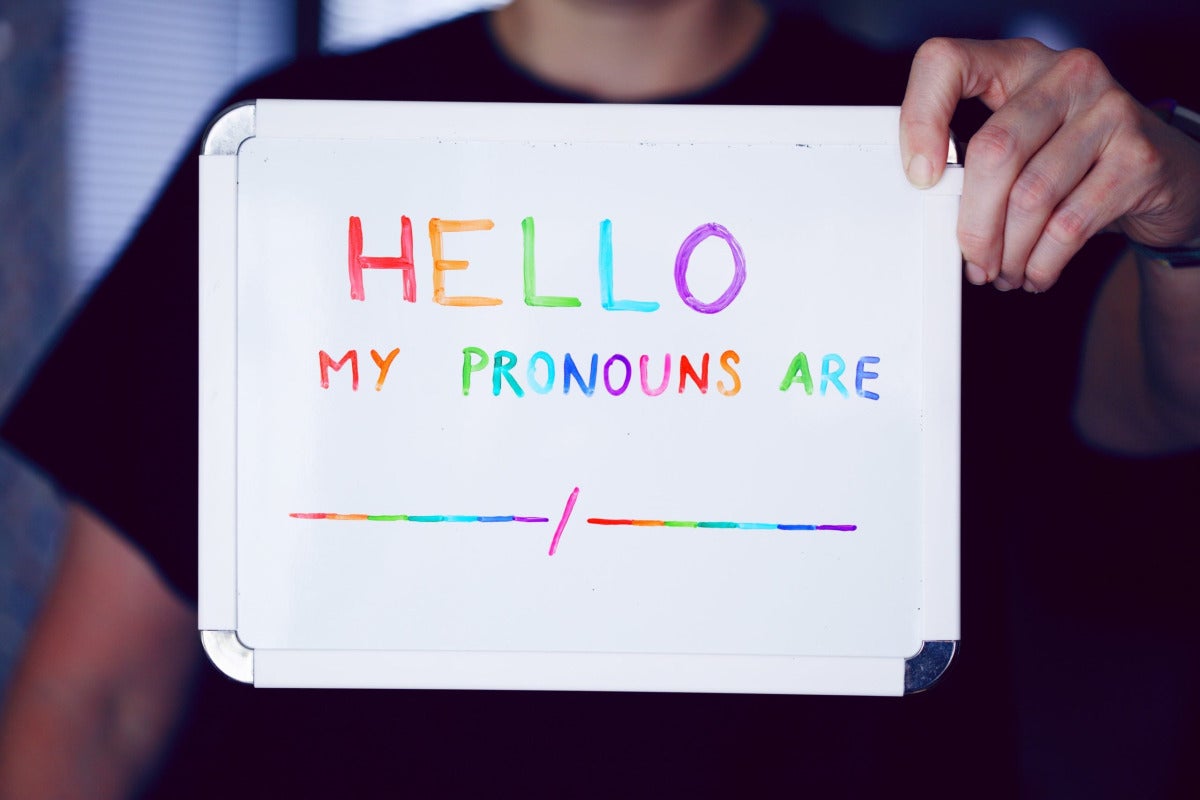
Pronouns are typically used to refer to a person when not using their name and are often associated with gender. It is important to not make assumptions about the gender of another person and to use their correct pronouns. Using the correct gender is an affirming and respectful practice (Shea, 2021). Social affirmation, which includes calling a student by their chosen name and personal pronouns, increases a sense of belonging in the classroom (Norris & Welch, 2020). Throughout this blog, we will highlight the purpose of pronoun sharing paired with strategies to use in your teaching practice.
“It is a privilege to not have to worry about which pronoun someone is going to use for you based on how they perceive your gender. If you have this privilege, yet fail to respect someone else’s gender identity, it is not only disrespectful and hurtful, but also oppressive” (p.1).
– University of Wisconsin, Milwaukee, LGBTQ+ Resource Center
“1 in 4 LGBTQ+ youth use pronouns outside of the gender binary.”
Misgendering is addressing people with incorrect gender pronouns, after they have clearly identified the pronouns that they use. Even if misgendering is unintentional, it causes stress for the person who has been misgendered (Nordmarken, 2014, Spade, 2011).
There are several common phrases that people use naturally, and have used over time, that reference particular genders. We often use these terms without realizing the harm their language may cause to folks who do not identify with the assumed gender. Try to pay attention to your language and find ways to incorporate gender-neutral terms, like ours listed below.
Sharing pronouns as a teaching practice must involve a strong personal connection to values of inclusivity. Identify your DU community partners to process misgendering, deadnaming (calling a trans person by their birth name after they have adopted a new name), and other mistakes that might cause mistrust and disconnection from your students (Sinclair-Palm, 2017). Keep reading and reflecting on the experiences of nonbinary and gender fluid students and continually challenge yourself to deconstruct gender binary structures in your language.
Nordmarken, S. (2014). “Microaggressions”. Transgender Quarterly. 1: 129-134. https://doi.org/10.1215/23289252-2399812
Norris, M. & Welch, A. (2020). “Gender pronoun use in the university classroom: A post-humanist perspective”. Transformation in Higher Education. 5. DOI:10.4102/the.v5i0.79
Shea, H. (Host). (2021, December 1). Beyond Pronouns (No. 73) [Audio podcast episode]. In Student Affairs NOW. https://studentaffairsnow.com/pronouns/
Sinclair-Palm, J. (2017). “It’s Non-Existent”: Haunting in Trans Youth Narratives about Naming. Occasional Paper Series, 2017 (37). Retrieved from https://educate.bankstreet.edu/occasional-paper-series/vol2017/iss37/7
Spade, D. (2011). “Some Very Basic Tips for Making Higher Education More Accessible to Trans Students and Rethinking How We Talk about Gendered Bodies”. Radical Teaching. 92: 57-62.
The Trevor Project. (2020). National Survey on LGBTQ Mental Health. New York, New York: The Trevor Project. Retrieved from https://www.thetrevorproject.org/research-briefs/pronouns-usage-among-lgbtq-youth/
University of Wisconsin, Milwaukee, LGBTQ+ Resource Center (n.d.) Why is it important to respect people’s pronouns? University of Wisconsin Milwaukee. Retrieved from https://uwm.edu/lgbtrc/qa_faqs/why-is-it-important-to-respect-peoples-pronouns/.