





Weekly Letter from the Provost—Feb. 27 Edition
Dear colleagues,
This weekly newsletter will serve as one of many tools my office will use to keep you informed and engaged as we make progress toward our three goals for Academic Affairs. We are grateful for your interest and support. Previous newsletters can be found on the provost’s communication center on the University’s website.
If you have suggestions for what we should include in future communications, please submit your ideas or stories here. Suggestions received before noon on Monday will be reviewed and considered for publication in that week’s newsletter. Others will be held for consideration until the following week.
Today’s update falls into four categories:
This weekly newsletter will serve as one of many tools my office will use to keep you informed and engaged as we make progress toward our three goals for Academic Affairs. We are grateful for your interest and support. Previous newsletters can be found on the provost’s communication center on the University’s website.
If you have suggestions for what we should include in future communications, please submit your ideas or stories here. Suggestions received before noon on Monday will be reviewed and considered for publication in that week’s newsletter. Others will be held for consideration until the following week.
Today’s update falls into four categories:
- Campus news and happenings
- Goal 1: Shape enrollment and improve retention and graduation rates for all students
- Goal 2: Improve career outcomes and better prepare our students to succeed and lead in an AI-transformed workforce
- Goal 3: Strengthen academic excellence
Campus News and Happenings
New Research Institutes and Centers Celebration
Thank you to all who were able to attend Wednesday’s third annual event to celebrate DU’s newly designated research institutes and centers. This year’s event also provided a venue to announce DU’s inaugural Research, Scholarship, and Creative Works Awards. Please join me in congratulating this year’s awardees:
New Research Institute
- Biodiversity Research Institute—Robin Tinghitella, College of Natural Sciences and Mathematics
New Research Centers
- Center for Housing and Homelessness Research—Daniel Brisson, Graduate School of Social Work
- Center for Housing Research & Innovative Solutions—Susan Daggett, Sturm College of Law and Vivek Sah, Daniels College of Business
- Center for Rural School Health & Education—Savannah Hobbs, Morgridge College of Education
Research Scholar Award – Emerging
- Allegra Aron, College of Natural Sciences and Mathematics
- Linda Méndez-Barrientos, Josef Korbel School of Global and Public Affairs
- Jonathan Velotta, College of Natural Sciences and Mathematics
Research Scholar Award – Established
- Marie Berry, Josef Korbel School of Global and Public Affairs
- Lauren McGrath, College of Arts, Humanities, and Social Sciences
- Scott Nichols, College of Natural Sciences and Mathematics
- Robin Tinghitella, College of Natural Sciences and Mathematics
Research Scholar Award – Eminent
- Pilyoung Kim, College of Arts, Humanities, and Social Sciences
- Shannon Murphy, College of Natural Sciences and Mathematics
- Galena Rhoades, College of Arts, Humanities, and Social Sciences
- Don Bergh, Daniels College of Business
Creative Works Award
- Remy Le Boeuf, College of Arts, Humanities, and Social Sciences
Research, Scholarship, and Creative Works Impact Award
- Justin Marceau, Sturm College of Law
- Robin Leake, Graduate School of Social Work
- Pardee Institute, Josef Korbel School of Global and Public Affairs
Translational Impact Award
- Amy He, Graduate School of Social Work
- Bridging the Gap Project, Josef Korbel School of Global and Public Affairs
Mentoring Impact Award
- Alexi Freeman, Sturm College of Law
- Jennifer Hoffman, College of Natural Sciences and Mathematics
- Christine Nelson, Morgridge College of Education
A special thanks to Corinne Lengsfeld, senior vice provost for research and graduate education, and her team for organizing such a beautiful and inspirational event.
Join Me for Lunch
Please join me in the faculty lounge (Community Commons 2800) from noon-1 p.m. on Monday, March 2 for our “First and Third Mondays” lunch. Bring your food, questions, and ideas—I look forward to engaging with you.
For reference, here are the dates reserved for lunches for the remainder of the winter and spring quarters:
For reference, here are the dates reserved for lunches for the remainder of the winter and spring quarters:
- March 16
- April 6
- April 20
- May 6 (due to travel on May 4)
- May 18
- June 1
University Council Winter Quarter Meeting Recap
On Thursday, my office coordinated the winter quarter’s University Council meeting. I wish to thank Chancellor Jeremy Haefner, Mark DeLorenzo, senior vice chancellor of business and financial affairs, Jeff Banks, vice chancellor for human resources, Sarah Watamura, Faculty Senate president, and Abigail Girard, Staff Senate president, for their contributions to the meeting’s agenda.
During these times of significant change and uncertainty, this meeting gave presenters an opportunity to engage University leaders in dialogue on forthcoming budget adjustments and offer guidance for leaders in supporting their teams with compassion, transparency, and steadiness.
We are committed to equipping impacted employees and their supervisors with tools and resources to navigate the challenging times ahead with dignity, consistency, and compassion. In yesterday’s meeting, Jeff Banks reviewed the resources and supports available within DU’s legal, financial, and HR domains. Chancellor Haeffner acknowledged that the amount of change we will be navigating over the next several months could require additional support. We are exploring a range of possibilities at this stage and will share more information in the days and weeks ahead. While we consider third-party expertise, I recognize we have incredible talent here within our own faculty. Please be on the lookout for a message from Sarah Watamura inviting faculty volunteers if this is of interest to you.
During these times of significant change and uncertainty, this meeting gave presenters an opportunity to engage University leaders in dialogue on forthcoming budget adjustments and offer guidance for leaders in supporting their teams with compassion, transparency, and steadiness.
We are committed to equipping impacted employees and their supervisors with tools and resources to navigate the challenging times ahead with dignity, consistency, and compassion. In yesterday’s meeting, Jeff Banks reviewed the resources and supports available within DU’s legal, financial, and HR domains. Chancellor Haeffner acknowledged that the amount of change we will be navigating over the next several months could require additional support. We are exploring a range of possibilities at this stage and will share more information in the days and weeks ahead. While we consider third-party expertise, I recognize we have incredible talent here within our own faculty. Please be on the lookout for a message from Sarah Watamura inviting faculty volunteers if this is of interest to you.
Academic Affairs Budget Retreat Follow-Up Meeting Recap
As a continuation of our full-day budget retreat last December, my academic leadership team, including deans and vice provosts, met this afternoon with leaders from across the university to collaborate around strategies to develop the FY27 budget in response to anticipated downward revenue shifts next fiscal year.
I will share further updates in subsequent newsletters, but the purpose of today’s meeting was to align on FY27 operating margin (OM) targets by academic division. I am grateful to the deans for their thoughtful and strategic deliberations to bring us to the OM targets. Thanks as well to the vice chancellors in the non-academic units for their willingness to engage in conversations with academic leaders about plans for non-academic budget reductions and the service implications associated with them.
I will share further updates in subsequent newsletters, but the purpose of today’s meeting was to align on FY27 operating margin (OM) targets by academic division. I am grateful to the deans for their thoughtful and strategic deliberations to bring us to the OM targets. Thanks as well to the vice chancellors in the non-academic units for their willingness to engage in conversations with academic leaders about plans for non-academic budget reductions and the service implications associated with them.
Goal 1: Shape Enrollment and Improve Retention and Graduation Rates
Updates from the Goal 1 Committee
The Goal 1 Committee has established three subcommittees, with subcommittee co-chairs, which will inform their efforts: you can review the revised committee and subcommittee assignments on the Provost Office website.
Work continues to strengthen enrollment through the development of coordinated marketing and recruitment strategies across undergraduate and graduate programs. For undergraduate recruitment, teams are enhancing the campus visit experience, elevating the visibility of distinctive classroom and research opportunities. For graduate recruitment, teams are clarifying marketing processes, improving program-level communication, and increasing flexibility in degree structures, with faster updates to program webpages. To cite one example, new marketing materials will showcase accelerated pathways to show prospective students a clear progression from undergraduate study into graduate degrees.
My continued thanks to committee chairs Corinne Lengsfeld, Todd Rinehart, and the entire Goal 1 Committee for their efforts.
Work continues to strengthen enrollment through the development of coordinated marketing and recruitment strategies across undergraduate and graduate programs. For undergraduate recruitment, teams are enhancing the campus visit experience, elevating the visibility of distinctive classroom and research opportunities. For graduate recruitment, teams are clarifying marketing processes, improving program-level communication, and increasing flexibility in degree structures, with faster updates to program webpages. To cite one example, new marketing materials will showcase accelerated pathways to show prospective students a clear progression from undergraduate study into graduate degrees.
My continued thanks to committee chairs Corinne Lengsfeld, Todd Rinehart, and the entire Goal 1 Committee for their efforts.
New Micro-Credential from Thrive Health Promotion
Thrive Health Promotion is proud to launch the Student Well-being Champion Badge (Levels 1 & 2). These badges equip faculty and staff learners with the knowledge, skills, and resources to support students with their well-being holistically. Participants gain foundational and advanced understanding of individual, interpersonal, and community-level health, covering topics such as understanding holistic student well-being and the social determinants of health, navigating substance use conversations, ongoing crisis support, bystander intervention, supporting survivors of interpersonal violence, and more.
To earn your badge:
Register for level 1 at the following website. Workshop dates will be finalized by the end of the winter quarter. The full schedule is available on our website or Crimson Connect. Upcoming dates can be found here for Mental Health First Aid sessions.
For questions, email Justin Stoeckle, associate director of wellness and prevention.
To earn your badge:
Register for level 1 at the following website. Workshop dates will be finalized by the end of the winter quarter. The full schedule is available on our website or Crimson Connect. Upcoming dates can be found here for Mental Health First Aid sessions.
For questions, email Justin Stoeckle, associate director of wellness and prevention.
Celebrate DU Leaders for Global Accessibility Awareness Day (GAAD)
Global Accessibility Awareness Day (GAAD) is coming soon! Take a moment to celebrate the people at DU who make our community one where everyone can thrive, regardless of neurotype or disability status. Nominate a student leader, faculty member, and/or staff member who has helped make the spaces, learning experiences, and digital events at DU more accessible. Then come join us at DU’s GAAD event to honor the recipients and engage with the campus community in meaningful conversations about digital access and inclusion.
DU Ranks High in Global Rankings of Academic Subjects (GRAS)
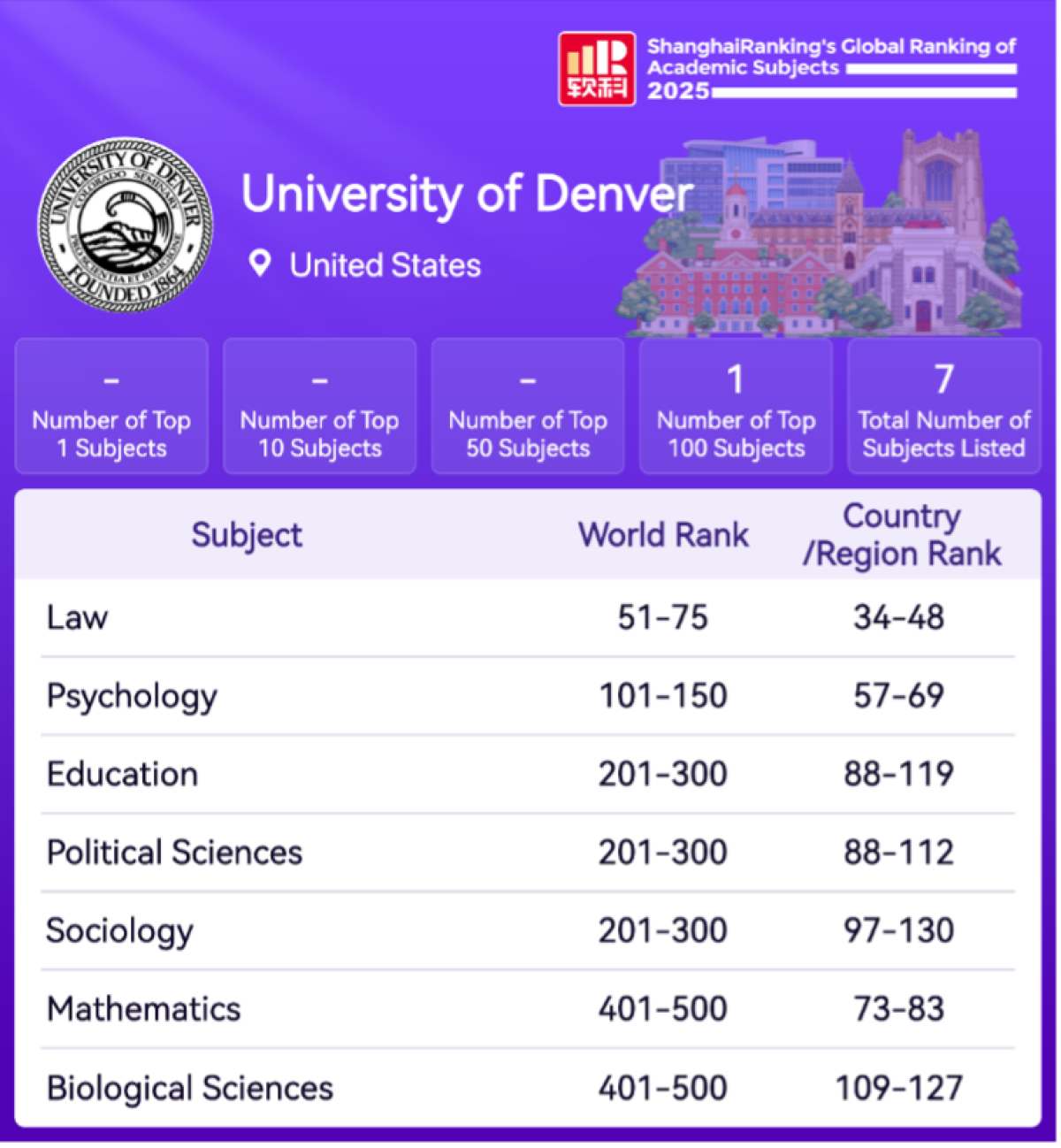
ShanghaiRanking is recognized as among the most preeminent and trustworthy sources of world and country rankings by academic subject. The organization released their first ranking in 2009. GRAS evaluates world universities across 57 subjects in the fields of natural sciences, engineering, life sciences, medical sciences, and social sciences. GRAS is based on nine objective indicators grouped into five categories: world-class faculty, world-class research output, high-quality research, research impact, and international collaboration. Each year, GRAS presents around 20,000 subject units from approximately 2,000 universities across nearly one hundred countries. To see the full methodology, check out GRAS’ website.
The infographic below depicts GRAS’ world and country (U.S.) 2025 rankings for the University of Denver. Congratulations to the seven academic units listed and recognized by GRAS for last year.
The infographic below depicts GRAS’ world and country (U.S.) 2025 rankings for the University of Denver. Congratulations to the seven academic units listed and recognized by GRAS for last year.
Goal 2: Improve Career Outcomes and Better Prepare Our Students to Succeed and Lead in an AI-transformed Workforce
Goal 2 Committee Updates
The Goal 2 Committee has established three subcommittees, with subcommittee co-chairs, which will inform their efforts: you can review the revised committee and subcommittee assignments on the Provost Office website.
The committee has entered into its vision and strategy phase, which will lead to identifying strategic goals and related key performance indicators (KPIs). The committee’s leadership group has discussed preliminary strategic themes, including institutionalization of localized innovative initiatives, systematization of employer engagement and experiential learning, and human-centered AI learning. The committee has also started mapping subcommittees’ recommendations with the committee charge received by the provost to enhance alignment and effectiveness of the committee’s work.
I offer continued thanks to committee chairs Liz Lierman, Lorenzo Patelli, and the entire Goal 2 Committee for their efforts.
The committee has entered into its vision and strategy phase, which will lead to identifying strategic goals and related key performance indicators (KPIs). The committee’s leadership group has discussed preliminary strategic themes, including institutionalization of localized innovative initiatives, systematization of employer engagement and experiential learning, and human-centered AI learning. The committee has also started mapping subcommittees’ recommendations with the committee charge received by the provost to enhance alignment and effectiveness of the committee’s work.
I offer continued thanks to committee chairs Liz Lierman, Lorenzo Patelli, and the entire Goal 2 Committee for their efforts.
Goal 3: Strengthen Academic Excellence
Goal 3 Committee Updates
As a reminder, the Goal 3 Committee has established three subcommittees, with subcommittee co-chairs, which will inform their efforts: you can review the revised committee and subcommittee assignments on the Provost Office website.
The Goal 3 Committee met this week to review subcommittee progress and the initial data tables under development to more fully understand academic units and programs. Deans will review this data in early March to provide their feedback, and to help interpret and refine the information before sharing it with chairs and directors.
The committee plans to utilize the following timeline as they develop their recommendations and engage community members before bringing these items forward:
The Goal 3 Committee met this week to review subcommittee progress and the initial data tables under development to more fully understand academic units and programs. Deans will review this data in early March to provide their feedback, and to help interpret and refine the information before sharing it with chairs and directors.
The committee plans to utilize the following timeline as they develop their recommendations and engage community members before bringing these items forward:
- Early March: Share with deans their academic unit data tables that will be used to support academic program reviews.
- By March 6: Form APT Review Committees to review potential academic unit closures. Committees will be composed of (as applicable) members from the Faculty Senate, Undergraduate Council, Graduate Council, and faculty from the relevant division, school or college that houses a potentially impacted unit.
- March-April: Work with deans to share academic unit data with their respective chairs and directors to gather feedback. Collaborate with deans, chairs, and directors to share academic unit data tables with the faculty and staff within each respective academic unit. Meet with academic units to discuss potential unit restructuring or closures with potentially impacted units. As recommendations take shape, involve the APT Review Committees.
- May: The Goal 3 Committee will submit a Recommendations Report to the provost. The provost will share Goal 3 recommendations with the DU community. Additional APT Review Committees will be launched as needed. APT Review Committees will submit their reports to the chancellor, provost, the chair of the Faculty Senate Academic Planning Committee, the chair of the Undergraduate Council, the chair of the Graduate Council, heads of affected unit(s), and deans of affected unit(s)
- June: The chancellor and provost will make final decisions (pending the Board of Trustees’ approval). Impacted units, faculty, and staff will receive notification.
- Implementation Timeline: Over the following 12 months, support faculty relocation as appropriate, prepare and begin to implement teach-out plans, and provide appeal and grievance processes for impacted individuals as provided under applicable policies. Program and academic unit changes will begin in the 2027-2028 academic year. DU is committed to enabling all current students, and those enrolling in fall 2026, to complete the program in which they are enrolled at that time without delay because of programmatic changes. Any program selected for closure will implement a teach-out plan to meet the needs of those students.
I express continued thanks to committee chairs Leslie Hasche, Jennifer Karas, and the entire Goal 3 Committee for their efforts. You may continue to send your ideas about Goal 3 to them. Leslie and Jennifer are also available for consultation to your academic units to describe the timeline and their efforts to align recommendations and implementation with the DU APT Policy.
GSSW Jeffrey Jenson Endowed Research Lecture
The GSSW invites community members to a special talk with Dr. Kaipeng Wang, former GSSW associate professor and current associate professor at the University of Washington’s School of Social Work. His research and scholarship focus on improving the lives and care experiences of older Asian American adults, especially within Chinese American communities.
Dr. Wang will share how his community partnerships and research help older adults make informed choices about their care, honor cultural values, and access support that respects their dignity. He will also highlight Heart to Heart Café, a culturally grounded program created with community members to make conversations about future care more comfortable, welcoming, and meaningful. This event celebrates the power of community-driven solutions, cultural understanding, and collaboration to build healthier, more equitable futures for older adults.
Craig Hall Community Room & Virtually
Monday, March 9, 2026
4-5:30 p.m. (MST)
2148 S. High Street
Denver, CO 80210
To RSVP, visit this website.
I wish you all the best and thank you for your service to our community.
Sincerely,
Elizabeth G. Loboa
Provost and Executive Vice Chancellor
Dr. Wang will share how his community partnerships and research help older adults make informed choices about their care, honor cultural values, and access support that respects their dignity. He will also highlight Heart to Heart Café, a culturally grounded program created with community members to make conversations about future care more comfortable, welcoming, and meaningful. This event celebrates the power of community-driven solutions, cultural understanding, and collaboration to build healthier, more equitable futures for older adults.
Craig Hall Community Room & Virtually
Monday, March 9, 2026
4-5:30 p.m. (MST)
2148 S. High Street
Denver, CO 80210
To RSVP, visit this website.
I wish you all the best and thank you for your service to our community.
Sincerely,
Elizabeth G. Loboa
Provost and Executive Vice Chancellor