







Weekly Letter from the Provost—Jan. 30 Edition
Dear colleagues,
This weekly newsletter will serve as one of many tools my office will use to keep you informed and engaged as we make progress toward our three goals for Academic Affairs. We are grateful for your interest and support. Previous newsletters can be found at the provost’s communication center on the University’s website.
If you have suggestions for what we should include in future communications, please submit your ideas or stories here. Suggestions received before noon on Monday will be reviewed and considered for publication in that week’s newsletter. Others will be held for consideration until the following week.
Today’s update falls into four categories:
This weekly newsletter will serve as one of many tools my office will use to keep you informed and engaged as we make progress toward our three goals for Academic Affairs. We are grateful for your interest and support. Previous newsletters can be found at the provost’s communication center on the University’s website.
If you have suggestions for what we should include in future communications, please submit your ideas or stories here. Suggestions received before noon on Monday will be reviewed and considered for publication in that week’s newsletter. Others will be held for consideration until the following week.
Today’s update falls into four categories:
- Campus news and happenings
- Goal 1: Shape enrollment and improve retention and graduation rates for all students
- Goal 2: Improve career outcomes and better prepare our students to succeed and lead in an AI-transformed workforce
- Goal 3: Strengthen academic excellence
Campus News and Happenings
International Holocaust Remembrance Day
On Tuesday, the University of Denver’s Center for Judaic Studies brought our community together at the state Capitol for an event that recognized International Holocaust Remembrance Day. I was honored to introduce Colorado’s Governor, Jared Polis, as we listened to and uplifted the stories of Holocaust survivors who were present. This week’s observance marks 81 years since the liberation of Auschwitz. Meeting at the Capitol, a site that embodies democratic ideals and civic responsibility, was a poignant reminder that democracy is a fragile and wonderful ideal, and that it survives only when people choose to act with courage.
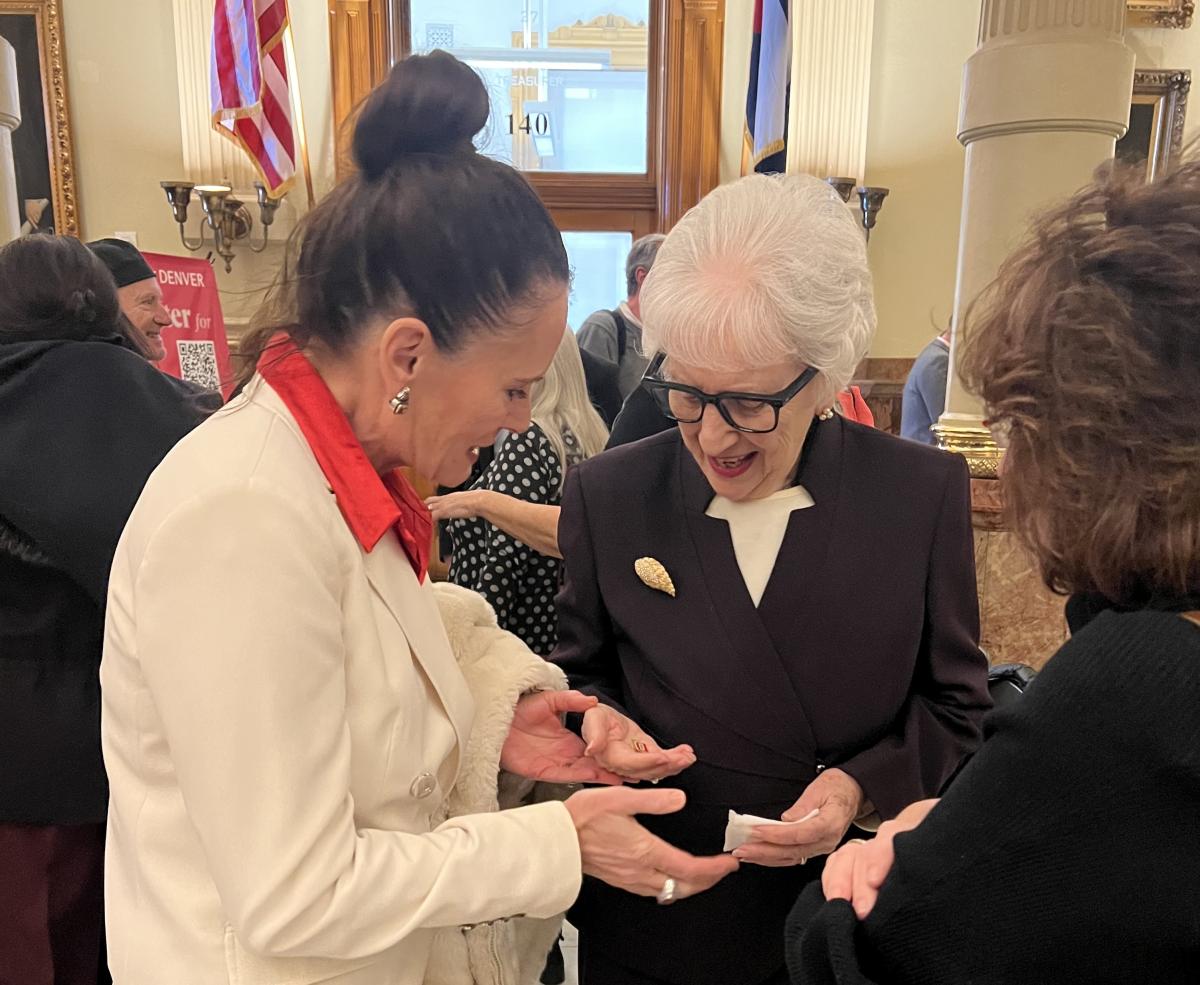
The gathering was moving, especially when I had the privilege to meet Holocaust survivors such as Osi Sladek and his wife, Selma Sladek, who is pictured above when she received her DU pin. They shared their powerful experiences with us, a memory that will stay with me for quite some time.
We must dedicate ourselves now to creating and sustaining a future filled with justice, human dignity, and mutual understanding through education. To support this critical effort, I was pleased to announce a new endowed professor for Holocaust and antisemitism studies at the University of Denver.
I wish to thank Adam Rovner, director of the Center for Judaic Studies, and the faculty and staff who bring its mission to life every day for this opportunity.
The gathering was moving, especially when I had the privilege to meet Holocaust survivors such as Osi Sladek and his wife, Selma Sladek, who is pictured above when she received her DU pin. They shared their powerful experiences with us, a memory that will stay with me for quite some time.
We must dedicate ourselves now to creating and sustaining a future filled with justice, human dignity, and mutual understanding through education. To support this critical effort, I was pleased to announce a new endowed professor for Holocaust and antisemitism studies at the University of Denver.
I wish to thank Adam Rovner, director of the Center for Judaic Studies, and the faculty and staff who bring its mission to life every day for this opportunity.
Board of Trustees Meeting Recap
I had multiple opportunities to update board members and committees on academic affairs at DU this week:
Faculty and Educational Affairs Committee (FEAC): My presentation focused on the Goal 1 Committee’s efforts to shape enrollment and improve graduation and retention rates for all students. I reviewed DU’s recent tuition revenue trends and forecasts, the need for DU to lean into a strategic enrollment management model, and concluded by presenting metrics on DU’s retention and graduation rates. Goal 1 Committee chairs, Todd Rinehart and Corinne Lengsfeld, provided updates on fall 2026 enrollment trends at the undergraduate and graduate levels. Deans Sahara Byrne (CAHSS), Michelle Sabick (RSECS), and Henrika McCoy (GSSW, MCE) spoke to the ways in which their academic units are supporting our goal 1 efforts. I encourage you to review this week’s FEAC presentation materials.
Key Performance Indicators (KPI) Lightning Round—Retention and Graduation: My brief presentation was a consolidated version of the slides I shared for the FEAC to provide board members the chance to review DU’s key performance indicators for retention and graduation. The presentation materials are available here.
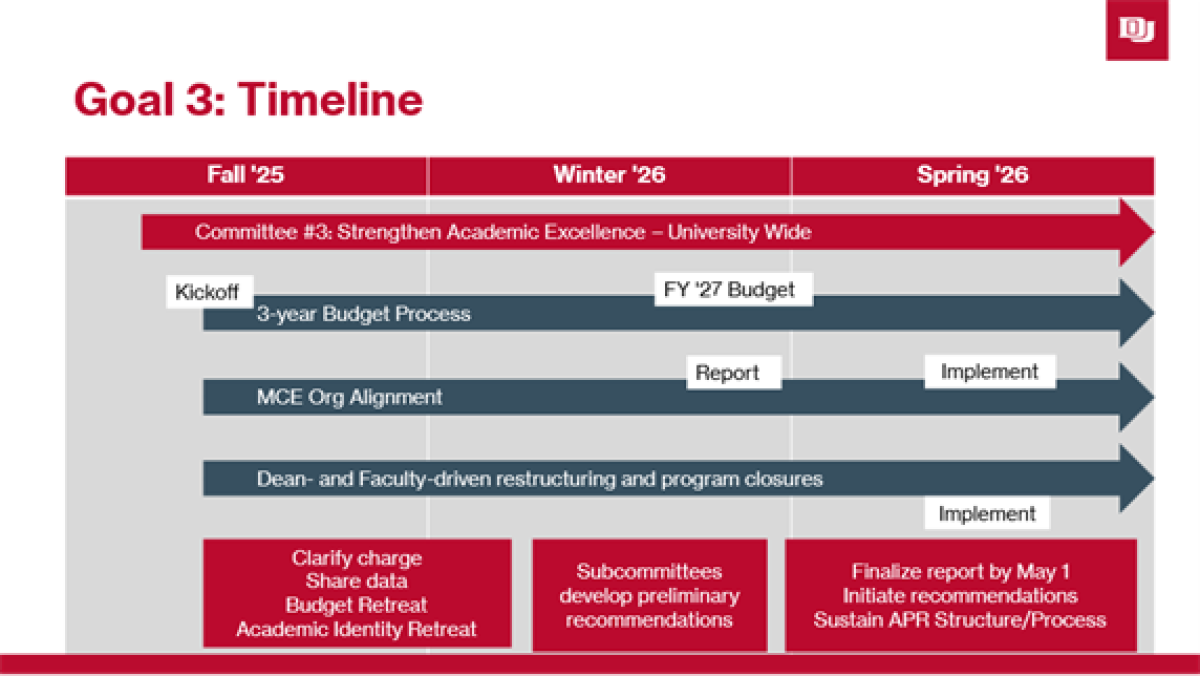
Executive Session—Academic Program Review (APR): For this part of the meeting, I focused on the Goal 3 Committee’s efforts toward even greater academic excellence at DU. I began the meeting emphasizing the importance of APRs (both to inform areas in which to invest and divest) and the need for DU to implement a rigorous and sustainable APR culture. I shared my expectation that the Goal 3 Committee’s work will help us establish this APR culture, and that we would bring forward recommendations during June’s board meeting about programs in which we should invest, restructure, or close. Dean Bobbie Kite (PSC) provided examples of the transformation underway within her unit. Goal 3 Committee Chairs Leslie Hasche and Jennifer Karas shared information about how their committee has been structured to support the work ahead of them, as well as their current timeline (see below in the goal 3 section for more information). I concluded the meeting by reviewing some of the data and visualization tools we as academic leaders, as well as members of the Goal 3 Committee, are using to inform recommendations.
Full Board Session: During today’s full board meeting, my provost report provided a consolidated version of the FEAC and Executive Session: APR presentations, with a heavy focus on the work of the Goals 1, 2, and 3 Committees and our roadmap for a new academic strategy at DU. Those slides are available here.
Faculty and Educational Affairs Committee (FEAC): My presentation focused on the Goal 1 Committee’s efforts to shape enrollment and improve graduation and retention rates for all students. I reviewed DU’s recent tuition revenue trends and forecasts, the need for DU to lean into a strategic enrollment management model, and concluded by presenting metrics on DU’s retention and graduation rates. Goal 1 Committee chairs, Todd Rinehart and Corinne Lengsfeld, provided updates on fall 2026 enrollment trends at the undergraduate and graduate levels. Deans Sahara Byrne (CAHSS), Michelle Sabick (RSECS), and Henrika McCoy (GSSW, MCE) spoke to the ways in which their academic units are supporting our goal 1 efforts. I encourage you to review this week’s FEAC presentation materials.
Key Performance Indicators (KPI) Lightning Round—Retention and Graduation: My brief presentation was a consolidated version of the slides I shared for the FEAC to provide board members the chance to review DU’s key performance indicators for retention and graduation. The presentation materials are available here.
Executive Session—Academic Program Review (APR): For this part of the meeting, I focused on the Goal 3 Committee’s efforts toward even greater academic excellence at DU. I began the meeting emphasizing the importance of APRs (both to inform areas in which to invest and divest) and the need for DU to implement a rigorous and sustainable APR culture. I shared my expectation that the Goal 3 Committee’s work will help us establish this APR culture, and that we would bring forward recommendations during June’s board meeting about programs in which we should invest, restructure, or close. Dean Bobbie Kite (PSC) provided examples of the transformation underway within her unit. Goal 3 Committee Chairs Leslie Hasche and Jennifer Karas shared information about how their committee has been structured to support the work ahead of them, as well as their current timeline (see below in the goal 3 section for more information). I concluded the meeting by reviewing some of the data and visualization tools we as academic leaders, as well as members of the Goal 3 Committee, are using to inform recommendations.
Full Board Session: During today’s full board meeting, my provost report provided a consolidated version of the FEAC and Executive Session: APR presentations, with a heavy focus on the work of the Goals 1, 2, and 3 Committees and our roadmap for a new academic strategy at DU. Those slides are available here.
Goal 1: Shape Enrollment and Improve Retention and Graduation Rates
Updates from the Goal 1 Committee
The Goal 1 Committee has established three subcommittees, with subcommittee co-chairs, which will inform their efforts: you can review the revised committee and subcommittee assignments on the Provost Office website.
During this week’s FEAC meeting, committee chairs, Todd Rinehart and Corinne Lengsfeld, updated the board on the committee’s work to date, highlighting the subcommittee structure that will inform their work moving forward. I offer my appreciation to the committee chairs and the entire Goal 1 Committee for their efforts.
During this week’s FEAC meeting, committee chairs, Todd Rinehart and Corinne Lengsfeld, updated the board on the committee’s work to date, highlighting the subcommittee structure that will inform their work moving forward. I offer my appreciation to the committee chairs and the entire Goal 1 Committee for their efforts.
Kennedy Mountain Campus Study Weekend
Staff from the Division of Student Affairs will host their first study weekend at the Kennedy Mountain Campus on Feb. 27-28.
Students are invited to step away from campus and into an environment designed to help them prepare for finals with intention. This overnight study retreat combines structured study sessions, restorative breaks, and community support. Registration is $15 and includes transportation, lodging, WiFi access, study supplies, and meals.
Know a student who might be interested? Please share this registration link.
Students are invited to step away from campus and into an environment designed to help them prepare for finals with intention. This overnight study retreat combines structured study sessions, restorative breaks, and community support. Registration is $15 and includes transportation, lodging, WiFi access, study supplies, and meals.
Know a student who might be interested? Please share this registration link.
Daniels College of Business Announces a New Director of Entrepreneurship
The Daniels College of Business is pleased to announce its new director of entrepreneurship, John Sebesta. Sebesta joined Daniels as an adjunct faculty member in 2020 and has been heavily involved in all of the college’s entrepreneurship programming, from teaching sections of the infamous “Fourth Industrial Business” course to mentoring budding entrepreneurs in the BASE Camp summer accelerator. In this new role, he will continue to hold the positions of Koch Endowed Chair of Entrepreneurship and professor of the practice.
Entrepreneurship@DU is housed in Daniels, but is open to all DU students. The program offers a full slate of workshops, speaker events, courses, microgrants, startup accelerators and more.
Entrepreneurship@DU is housed in Daniels, but is open to all DU students. The program offers a full slate of workshops, speaker events, courses, microgrants, startup accelerators and more.
Innovating the Graduate Admission Experience: Korbel’s Instant Decision Day Pilot
In December, the Josef Korbel School of Global and Public Affairs piloted an Instant Decision Day initiative, designed to accelerate time-to-decision, reduce applicant uncertainty, and improve the graduate admission experience for high-intent domestic applicants.
Held virtually, the pilot brought together Korbel’s Graduate Admissions team and the Office of Graduate Enrollment team to review completed applications and deliver same-day admission decisions following structured interviews. Through this process, Korbel admitted 29 high-quality students in a single day, all of whom met and exceeded established admission criteria. These talented new students include a Fulbright Scholarship recipient, a returned Peace Corps volunteer, and a veteran.
Beyond outcomes, the initiative demonstrated the value of speed, clarity, and human connection in the enrollment process at the graduate level. Participants consistently noted the accessibility and transparency of the format, particularly for students navigating graduate school decisions alongside work or other commitments. The pilot generated valuable insights that are informing enhancements to Korbel’s broader admissions process and future enrollment initiatives.
Building on this success, Korbel will run a second Instant Decision Day again in March. Members of the DU community with undergraduates or others considering graduate study should be on the lookout for this upcoming opportunity and share it with prospective students. For more information, please email korbeladm@du.edu.
Held virtually, the pilot brought together Korbel’s Graduate Admissions team and the Office of Graduate Enrollment team to review completed applications and deliver same-day admission decisions following structured interviews. Through this process, Korbel admitted 29 high-quality students in a single day, all of whom met and exceeded established admission criteria. These talented new students include a Fulbright Scholarship recipient, a returned Peace Corps volunteer, and a veteran.
Beyond outcomes, the initiative demonstrated the value of speed, clarity, and human connection in the enrollment process at the graduate level. Participants consistently noted the accessibility and transparency of the format, particularly for students navigating graduate school decisions alongside work or other commitments. The pilot generated valuable insights that are informing enhancements to Korbel’s broader admissions process and future enrollment initiatives.
Building on this success, Korbel will run a second Instant Decision Day again in March. Members of the DU community with undergraduates or others considering graduate study should be on the lookout for this upcoming opportunity and share it with prospective students. For more information, please email korbeladm@du.edu.
Goal 2: Improve Career Outcomes and Better Prepare Our Students to Succeed and Lead in an AI-transformed Workforce
Goal 2 Committee Updates
The Goal 2 Committee has established three subcommittees, with subcommittee co-chairs, which will inform their efforts: you can review the revised committee and subcommittee assignments on the Provost Office website.
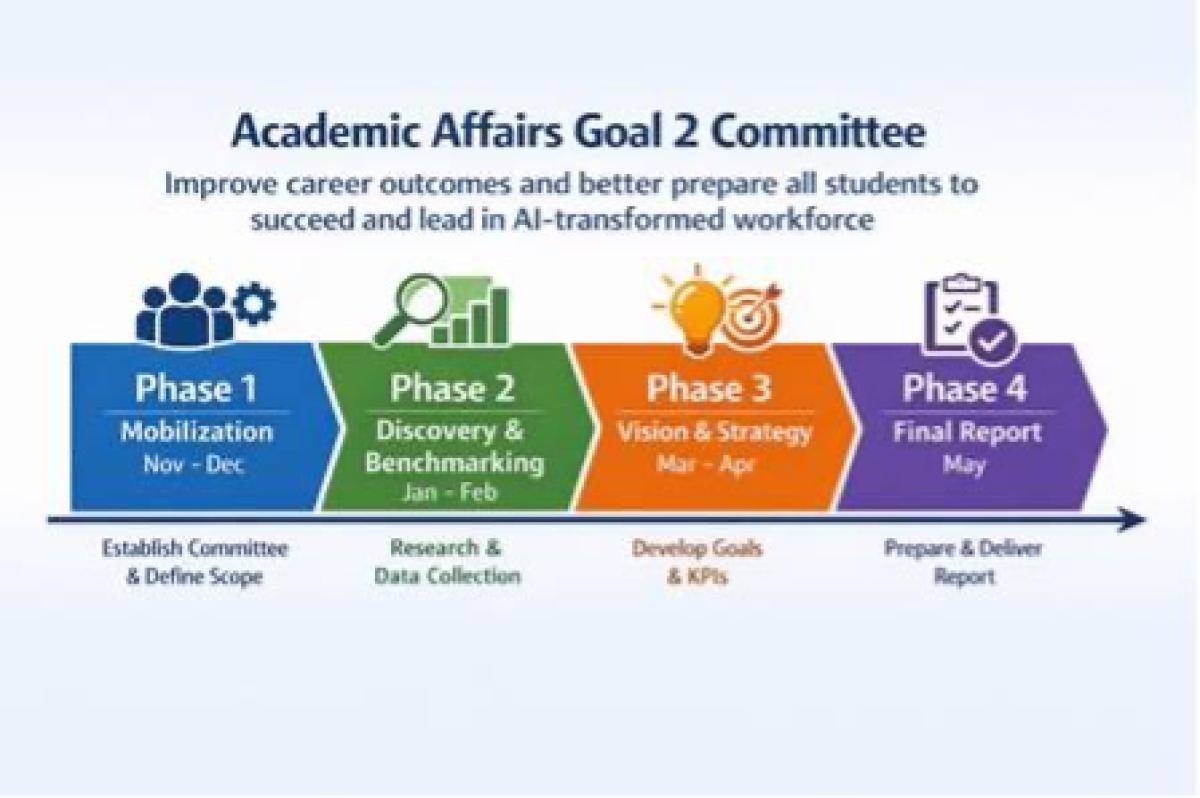
After successfully completing the mobilization phase in early January, the Goal 2 Committee is working on the discovery and benchmarking phase in February. The committee has reviewed existing career outcomes data and hosted presentations about other campus initiatives that support career outcomes (including 4D Fridays, Career Passport, and undergraduate internships).
More than 160 employers responded to the committee’s survey on workforce integration of AI, and data will be analyzed in relation to a literature review of AI academic policies, as well as AI initiatives at peer institutions. Lastly, the committee hosted a presentation about the Center for Ethical Generative AI Applications (CEGAIA) and discussed the student perspectives shared at the Office of Teaching and Learning’s (OTL) student panel on AI.
In late February and March, the committee will move to the next phase of its work, applying the information collected to the development of initial strategy recommendations. They will draft key performance indicators for improving career outcomes and student preparation for AI in the workforce.
The visual of the committee’s timeline is available below.
After successfully completing the mobilization phase in early January, the Goal 2 Committee is working on the discovery and benchmarking phase in February. The committee has reviewed existing career outcomes data and hosted presentations about other campus initiatives that support career outcomes (including 4D Fridays, Career Passport, and undergraduate internships).
More than 160 employers responded to the committee’s survey on workforce integration of AI, and data will be analyzed in relation to a literature review of AI academic policies, as well as AI initiatives at peer institutions. Lastly, the committee hosted a presentation about the Center for Ethical Generative AI Applications (CEGAIA) and discussed the student perspectives shared at the Office of Teaching and Learning’s (OTL) student panel on AI.
In late February and March, the committee will move to the next phase of its work, applying the information collected to the development of initial strategy recommendations. They will draft key performance indicators for improving career outcomes and student preparation for AI in the workforce.
The visual of the committee’s timeline is available below.
My continued thanks to committee chairs Liz Lierman, Lorenzo Patelli, and the entire Goal 2 Committee for their efforts.
Goal 3: Strengthen Academic Excellence
Goal 3 Committee Updates
As a reminder, the Goal 3 Committee has established three subcommittees, with subcommittee co-chairs, which will inform their efforts: you can review the revised committee and subcommittee assignments on the Provost Office website.
Committee chairs Leslie Hasche and Jennifer Karas joined me to update the board on the subcommittee structure that will inform their work. They also reviewed the workplan graphic included below that will inform their efforts during the winter and spring quarters.
Committee chairs Leslie Hasche and Jennifer Karas joined me to update the board on the subcommittee structure that will inform their work. They also reviewed the workplan graphic included below that will inform their efforts during the winter and spring quarters.
I encourage you to be on the lookout for additional information. The Goal 3 Committee is committed to reviewing its recommendations for program and departmental restructuring—and/or discontinuances with any potentially impacted academic units—prior to bringing them forward in its final recommendations to senior leadership.
I offer continued thanks to committee chairs Leslie Hasche, Jennifer Karas, and the entire Goal 3 Committee for their efforts.
I offer continued thanks to committee chairs Leslie Hasche, Jennifer Karas, and the entire Goal 3 Committee for their efforts.
Recent Faculty Awards and Honorifics
Please join us in celebrating six distinguished honors recently awarded to University of Denver faculty in recognition of their exceptional service, scholarship, and leadership in the humanities, education, psychology, and higher education studies:
- Ramona Beltrán and her community partner, Olga Gonzalez, are recipients of the 2026 Society for Social Work and Research (SSWR) Community-Research Partnership Award. Presented at the SSWR annual conference in mid-January, this award honors exemplary collaborative scholarship that advances community-engaged research and contributes meaningful impact to the social work field.
- Remy Le Boeuf, has been awarded the ISJAC/iJazz Music Peter Herbolzheimer Composition Prize by the International Society of Jazz Arrangers & Composers. This prestigious honor recognizes excellence and innovation in jazz composition, acknowledging his creative contributions to the field and his impact on contemporary jazz artistry.
- Douglas D. Hesse (Professor Emeritus) has received the 2025 Distinguished Service Award from the National Council of Teachers of English (NCTE), honoring his longstanding and influential contributions to the profession and to the national work of the NCTE.
- Noelle Lefforge has been named a Fellow of the American Academy of Group Psychology, a distinction that recognizes significant professional achievement and leadership in group psychology practice, research, and training.
- Darin M. L. Stewart has been elected a Fellow of the Association for the Study of Higher Education, an acknowledgment of his sustained contributions to research, scholarship, and leadership in the field of higher education.
- For her book Slips of the Mind: Poetry as Forgetting (University of Chicago Press), Jennifer Soong is the recipient of the 2025 Gustave O. Arlt Award in the Humanities from the Council of Graduate Schools, a prestigious national honor recognizing an outstanding contribution to scholarship in the humanities.
MCE Faculty Receive Recognition from the American College Personnel Association (ACPA) — College Student Educators International
Congratulations to MCE’s Marc Johnston Guerrero and Chayla Haynes Davison, who both received recognitions for their scholarship from ACPA—College Student Educators International, a prominent professional organization for student affairs in higher education.
Marc Johnston Guerrero, professor of higher education, received the Nancy J. Evans Voices of Inclusion Award. This honor recognizes members “who use their voices to make their campuses, the Association, and the field more equitable, inclusive, and just places.”
Chayla Haynes Davison (PhD ’13), a graduate of DU’s higher education doctoral program, has been named an ACPA Senior Scholar. This prestigious recognition is awarded to senior scholars whose exemplary, sustained contributions advance ACPA’s mission by creating influential scholarship, shaping critically reflective practice, and advocating for equitable and inclusive higher education environments.
Marc Johnston Guerrero, professor of higher education, received the Nancy J. Evans Voices of Inclusion Award. This honor recognizes members “who use their voices to make their campuses, the Association, and the field more equitable, inclusive, and just places.”
Chayla Haynes Davison (PhD ’13), a graduate of DU’s higher education doctoral program, has been named an ACPA Senior Scholar. This prestigious recognition is awarded to senior scholars whose exemplary, sustained contributions advance ACPA’s mission by creating influential scholarship, shaping critically reflective practice, and advocating for equitable and inclusive higher education environments.
University Writing Program Faculty Member Publishes New Book
Congratulations to Rebekah Shultz Colby, teaching professor in the University Writing Program, on the publication of her new book, Ludic Rhetoric: How Games Enhance Rhetorical Theory and Pedagogy (Parlor Press).
We wish you all a wonderful week, and I am grateful for your contributions to our campus community!
Sincerely,
Elizabeth G. Loboa
Provost and Executive Vice Chancellor
We wish you all a wonderful week, and I am grateful for your contributions to our campus community!
Sincerely,
Elizabeth G. Loboa
Provost and Executive Vice Chancellor