





Weekly Letter from the Provost—March 20 Edition
Dear colleagues,
This weekly newsletter will serve as one of many tools my office will use to keep you informed and engaged as we make progress toward our three goals for Academic Affairs. We are grateful for your interest and support. Previous newsletters can be found on the provost’s communication center on the University’s website.
If you have suggestions for what we should include in future communications, please submit your ideas or stories here. Suggestions received before noon on Monday will be reviewed and considered for publication in that week’s newsletter. Others will be held for consideration until the following week.
Today’s update falls into four categories:
This weekly newsletter will serve as one of many tools my office will use to keep you informed and engaged as we make progress toward our three goals for Academic Affairs. We are grateful for your interest and support. Previous newsletters can be found on the provost’s communication center on the University’s website.
If you have suggestions for what we should include in future communications, please submit your ideas or stories here. Suggestions received before noon on Monday will be reviewed and considered for publication in that week’s newsletter. Others will be held for consideration until the following week.
Today’s update falls into four categories:
- Campus news and happenings
- Goal 1: Shape enrollment and improve retention and graduation rates for all students
- Goal 2: Improve career outcomes and better prepare our students to succeed and lead in an AI-transformed workforce
- Goal 3: Strengthen academic excellence
Campus News and Happenings
DU Retirees Luncheon
On Wednesday, I joined the DU Retirees Association for their spring luncheon. It was great to spend time getting to know some of the many retired faculty and staff who remain interested in, and committed to, the University’s success. My presentation focused on DU’s academic transformation efforts, and I learned a great deal from attendees on what makes our institution special. It is my strong desire that we retain as much of this distinctiveness as possible even as we reimagine the DU of the future.
Goal 1: Shape Enrollment and Improve Retention and Graduation Rates
Updates from the Goal 1 Committee
The Goal 1 Committee has established three subcommittees, with subcommittee co-chairs, which will inform their efforts: you can review the revised committee and subcommittee assignments on the Provost Office website.
The committee is identifying approaches to elevate DU’s distinctiveness by exploring investments in campus traditions, co-curricular activities, enhanced campus visit experiences at the Cable Center, and coordinated international student recruitment across schools and colleges. The group is reviewing opportunities for consistent and compelling branding of accelerated master’s programs, shared graduate career fair infrastructure, and clearer undergraduate to graduate pathways. These developments are occurring alongside improved coordination between central teams and academic units to support yield.
My continued thanks to committee chairs Corinne Lengsfeld, Todd Rinehart, and the entire Goal 1 Committee for their efforts.
The committee is identifying approaches to elevate DU’s distinctiveness by exploring investments in campus traditions, co-curricular activities, enhanced campus visit experiences at the Cable Center, and coordinated international student recruitment across schools and colleges. The group is reviewing opportunities for consistent and compelling branding of accelerated master’s programs, shared graduate career fair infrastructure, and clearer undergraduate to graduate pathways. These developments are occurring alongside improved coordination between central teams and academic units to support yield.
My continued thanks to committee chairs Corinne Lengsfeld, Todd Rinehart, and the entire Goal 1 Committee for their efforts.
DU Forward Project Updates: Announcing the Launch of New Undergraduate Learning Cohorts
The DU Forward project, “Student Research as Signature Work for Public Good Impact,” is pursuing several strategies to increase student preparation and opportunities for undergraduate research as signature work. One of those strategies is a new cohort-based learning program that brings together undergraduate students with mentorship teams comprised of faculty, staff, graduate students, and community mentors to explore multidisciplinary themes. The first cohort launched during the winter quarter and was led by Professor Alejandro Ceron. With the theme, “The Future of Health,” the undergraduate students are working with graduate student mentors from the College of Natural Sciences and Mathematics (NSM), the Ritchie School of Engineering and Computer Science (RSECS), and community mentors in both government and non-profit leadership roles. This new model for learning cohorts was featured in U.S. News & World Report last week.
Student Research as Signature Work for the Public Good
The Student Research as Signature Work for Public Good Impact project of DU Forward has established a new group of Research Champions. These undergraduate students from across campus are working with graduate students and faculty mentors to help current and prospective students learn more about pathways to research as part of a DU education. More information about the inaugural group of Research Champions is provided on this website.
On April 9, the Research Champions will host an event to showcase the relevant skills students develop while conducting research we know employers seek. Please share the following details with students in your classrooms or through Canvas:
Thinking About Doing Research Next Year? Employers Want You to Say Yes! Here's Why.
A panel conversation with DU's undergraduate Research Champions, facilitated by Carolyn Sommers in the Office of Career & Professional Development.
Date: April 9, 4 to 5 p.m.
Location: Sturm Hall 134
This event is sponsored by the Office for Public Good Strategy and Research and the Office of Career & Professional Development.
On April 9, the Research Champions will host an event to showcase the relevant skills students develop while conducting research we know employers seek. Please share the following details with students in your classrooms or through Canvas:
Thinking About Doing Research Next Year? Employers Want You to Say Yes! Here's Why.
A panel conversation with DU's undergraduate Research Champions, facilitated by Carolyn Sommers in the Office of Career & Professional Development.
Date: April 9, 4 to 5 p.m.
Location: Sturm Hall 134
This event is sponsored by the Office for Public Good Strategy and Research and the Office of Career & Professional Development.
Public Good Storytelling Survey
As part of DU Forward, the Public Good Storytelling project will develop an ongoing, multichannel storytelling strategy to celebrate the academic work and collaborations that have local impact and make DU Denver’s university. As this project begins, faculty and staff are invited to share current perceptions of DU’s impact on the public good by filling out a brief survey. The survey should take about 15 minutes and will ask about participants’ definitions of the public good, as well as related perceptions of it at DU. To read more and access the survey, please follow this link by March 30. For questions, please reach out to Anne DePrince or Brad Bohlander, the project co-leads.
Goal 2: Improve Career Outcomes and Better Prepare Our Students to Succeed and Lead in an AI-transformed Workforce
Goal 2 Committee Updates
The Goal 2 Committee has established three subcommittees, with subcommittee co-chairs, which will inform their efforts: you can review the revised committee and subcommittee assignments on the Provost Office website.
Last week, the committee met with me to share their discovery phase findings, preliminary recommendations, and key performance indicators (KPIs) as part of the strategy and vision phase. Next, the committee will complement its work to date with continued development of KPIs, marketing and visibility recommendations, student input, and further development of the five major themes it has identified for its report: 1) leveraging DU’s strengths and innovations; 2) universal responsible and ethical AI literacy as a differentiated value proposition; 3) enhancing and scaling employer engagement; 4) internships and experiential learning to drive career readiness; and 5) broadening and building on first-destination career outcomes measures.
The committee encourages anyone across campus to contact Liz Lierman, Lorenzo Patelli, or any member of the committee if they have ideas or suggestions, especially around initiatives, that address the five themes above.
Last week, the committee met with me to share their discovery phase findings, preliminary recommendations, and key performance indicators (KPIs) as part of the strategy and vision phase. Next, the committee will complement its work to date with continued development of KPIs, marketing and visibility recommendations, student input, and further development of the five major themes it has identified for its report: 1) leveraging DU’s strengths and innovations; 2) universal responsible and ethical AI literacy as a differentiated value proposition; 3) enhancing and scaling employer engagement; 4) internships and experiential learning to drive career readiness; and 5) broadening and building on first-destination career outcomes measures.
The committee encourages anyone across campus to contact Liz Lierman, Lorenzo Patelli, or any member of the committee if they have ideas or suggestions, especially around initiatives, that address the five themes above.
Burns School Hosts High Energy Career Expo
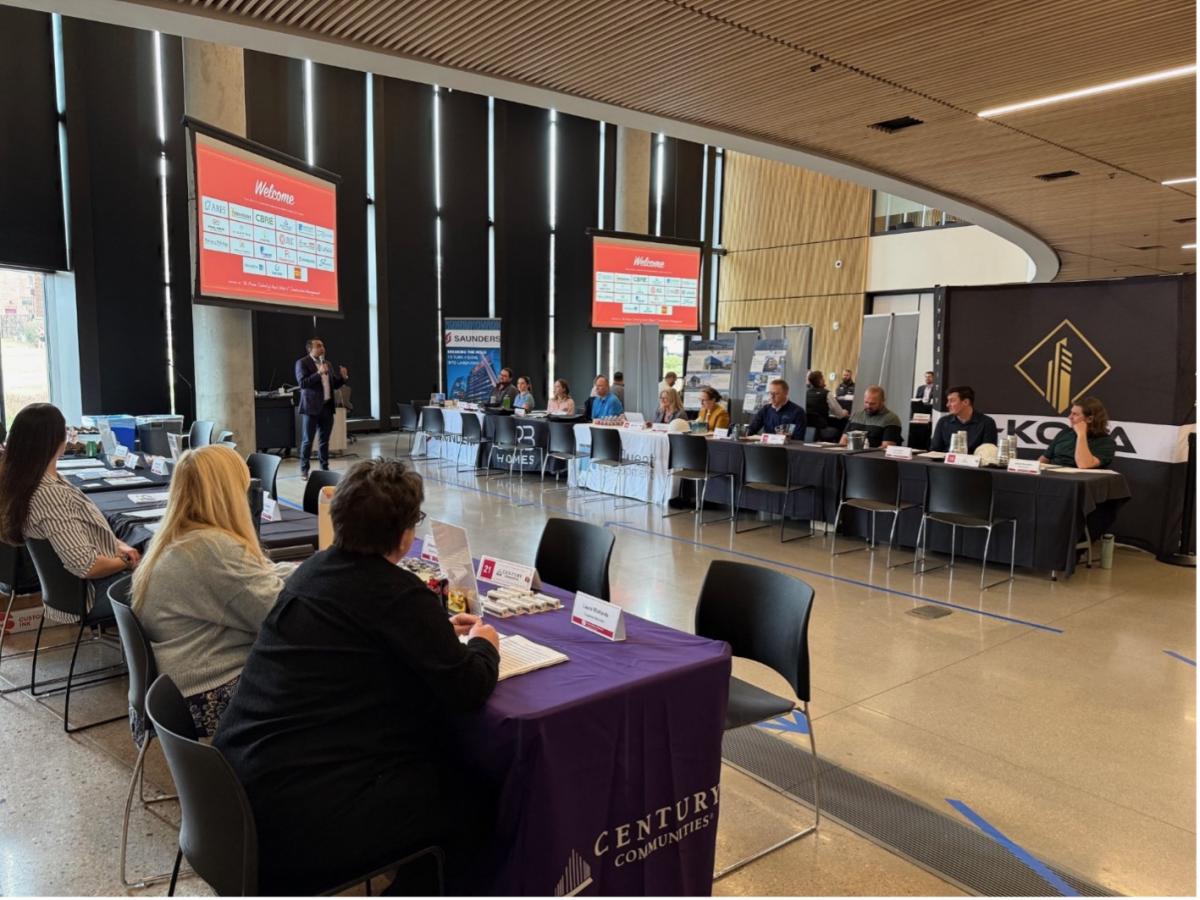
The Daniels College of Business’ Burns School of Real Estate and Construction Management brought students and employers together for its fourth annual Career Expo on Feb. 27, delivering a dynamic and impactful recruiting experience.
This year’s event welcomed 21 companies actively hiring across real estate finance and investments, real estate development, and construction management. To maximize connection and momentum, students paired up and rotated through employer tables in a fast-paced speed interview format, creating an energetic atmosphere and meaningful one-on-one conversations.
The innovative format was a hit with both students and employers, many of whom praised the event for its efficiency, organization, and strong employer lineup. The Burns School Career Expo was the culmination of a full week of panels and prep sessions—it continues to be a cornerstone event, connecting students with industry professionals for internships and job opportunities upon graduation.
This year’s event welcomed 21 companies actively hiring across real estate finance and investments, real estate development, and construction management. To maximize connection and momentum, students paired up and rotated through employer tables in a fast-paced speed interview format, creating an energetic atmosphere and meaningful one-on-one conversations.
The innovative format was a hit with both students and employers, many of whom praised the event for its efficiency, organization, and strong employer lineup. The Burns School Career Expo was the culmination of a full week of panels and prep sessions—it continues to be a cornerstone event, connecting students with industry professionals for internships and job opportunities upon graduation.
DU’s AI Steering Committee Relaunches on March 30
The University of Denver’s AI Steering Committee will relaunch its work on March 30, 2026. This cross-campus group brings together academic leaders, researchers, and operational experts to guide DU’s approach to artificial intelligence in alignment with our academic mission and institutional values. A central priority of this renewed effort is to ensure all members of the DU community use AI in responsible, transparent, and ethical ways that support learning, scholarship, and operational excellence.
In this renewed phase, the committee will focus on three core tasks:
In this renewed phase, the committee will focus on three core tasks:
1. Support Academic Affairs with guidelines and guardrails that help faculty and academic units navigate AI in teaching, learning, and research while reinforcing ethical practices.
2. Define administrative and operational guidelines and guardrails that promote responsible, compliant, and transparent uses of AI across university functions.
3. Identify opportunities for DU to use AI to improve efficiency and reduce institutional expenses without compromising integrity, academic rigor, or the student experience.
Committee Members (alphabetized by last name):
- Leslie Cramblet Alvarez
- Alain Bouit
- Naomi Boyd
- Dan Fischer
- Eric Hartman
- Harper Johnson
- Bruce Klaw
- Michael Levine-Clark
- Terese Rainwater
- Michelle Sabick
- Margaret Tezak
- Gohar Tovbis
Goal 3: Strengthen Academic Excellence
Goal 3 Committee Updates
The Goal 3 Committee has established three subcommittees, with subcommittee co-chairs, which will inform their efforts: you can review the revised committee and subcommittee assignments on the Provost Office website.
In last week’s meeting, the committee and I had a good conversation about role clarity in the weeks and months ahead as recommendations come forward for review and approval, and I wanted to share the highlights of that discussion with each of you.
Several groups are now working simultaneously toward delivering recommendations on program adjustments by the June 2026 board meeting: 1) The Goal 3 Committee, 2) DU’s academic deans, and 3) the Academic Unit Review Committee, which includes, among others, representatives elected from the Faculty Senate.
Moving forward, I see the priority for the Goal 3 Committee to offer recommendations in its May 1 report that reflect the work of its three subcommittees around program investment, restructuring, and closures, as well as how to implement and sustain potential recommendations. The committee will not be responsible for making decisions, but they have the valuable role of providing guidance on the range of possibilities, contexts to consider, and thoughts for how to implement and sustain the academic transformation efforts.
Deans, with my support, are charged with responding to the current budget demands for FY27 and are making decisions that may align and be informed by the Goal 3 Committee’s work. Deans will also be the ones to work within their college’s relevant curriculum procedures to implement closure of academic programs.
I am also working with Faculty Senate President Sarah Watamura to stand up Academic Unit Review Committees, which will consist of faculty elected from the contributing division, school, or college, Undergraduate and Graduate Councils, and the Faculty Senate Academic Affairs Committee. These committees will play an important role by evaluating potential academic unit discontinuation and making recommendations, following the process set forth in the APT.
Working with the chancellor, I will be responsible for decisions regarding academic transformation that will go into effect in FY28, including recommendations to discontinue academic units (i.e., APT homes)—which may lead to termination of faculty lines. These recommendations will be presented during the June 2026 board meeting for review and approval by the Board of Trustees prior to implementation.
We appreciate the DU community’s continued patience as we work through these developmental steps that will inform the Goal 3 recommendations. Please contact Jennifer Karas or Leslie Hasche with ideas or requests to join conversations about the Goal 3 approach. Many committee members will be on spring break next week, and I hope the same is true for many of you. As such, we do not anticipate significant developments or announcements from this committee next week.
In last week’s meeting, the committee and I had a good conversation about role clarity in the weeks and months ahead as recommendations come forward for review and approval, and I wanted to share the highlights of that discussion with each of you.
Several groups are now working simultaneously toward delivering recommendations on program adjustments by the June 2026 board meeting: 1) The Goal 3 Committee, 2) DU’s academic deans, and 3) the Academic Unit Review Committee, which includes, among others, representatives elected from the Faculty Senate.
Moving forward, I see the priority for the Goal 3 Committee to offer recommendations in its May 1 report that reflect the work of its three subcommittees around program investment, restructuring, and closures, as well as how to implement and sustain potential recommendations. The committee will not be responsible for making decisions, but they have the valuable role of providing guidance on the range of possibilities, contexts to consider, and thoughts for how to implement and sustain the academic transformation efforts.
Deans, with my support, are charged with responding to the current budget demands for FY27 and are making decisions that may align and be informed by the Goal 3 Committee’s work. Deans will also be the ones to work within their college’s relevant curriculum procedures to implement closure of academic programs.
I am also working with Faculty Senate President Sarah Watamura to stand up Academic Unit Review Committees, which will consist of faculty elected from the contributing division, school, or college, Undergraduate and Graduate Councils, and the Faculty Senate Academic Affairs Committee. These committees will play an important role by evaluating potential academic unit discontinuation and making recommendations, following the process set forth in the APT.
Working with the chancellor, I will be responsible for decisions regarding academic transformation that will go into effect in FY28, including recommendations to discontinue academic units (i.e., APT homes)—which may lead to termination of faculty lines. These recommendations will be presented during the June 2026 board meeting for review and approval by the Board of Trustees prior to implementation.
We appreciate the DU community’s continued patience as we work through these developmental steps that will inform the Goal 3 recommendations. Please contact Jennifer Karas or Leslie Hasche with ideas or requests to join conversations about the Goal 3 approach. Many committee members will be on spring break next week, and I hope the same is true for many of you. As such, we do not anticipate significant developments or announcements from this committee next week.
Announcing: The Resilient Scientist Series
Science and healthcare careers are filled with challenges, failed projects, critical feedback, disappointing outcomes, difficult relationships, and uncertainty about the future. Because we care so much, these experiences can lead to stress, persistent self-doubt, and burnout—turning a dream career into a nightmare.
DU’s 4D Experience is pleased to announce the nationally recognized, five-part Resilient Scientist Series, which is facilitated by Dr. Sharon Milgram, the former director of the NIH Office of Intramural Training and Education. This series is designed to focus on building resilience, adopting healthy mindsets, supporting well-being, and fostering professional growth. Participants will learn evidence-based tools to respond effectively to stress, uncertainty, and change, with the goal of developing skills to support a productive and fulfilling career. The content is tailored for modern research and academic environments, providing practical strategies that can be applied immediately and over the long term.
The series is suitable for advanced undergraduates, post-bacs, graduate students, professional school students, and postdoctoral fellows. While focused on school and work, the realities of current events and applying these skills to our lives will also be addressed.
Click here to register for the series.
The Resilient Scientist: Tools for Thriving in Academic and Research Environments
Mondays, 1 to 2:30 p.m., starting March 30, 2026
I wish you all the best as we enter the spring season.
Sincerely,
Elizabeth G. Loboa
Provost and Executive Vice Chancellor
DU’s 4D Experience is pleased to announce the nationally recognized, five-part Resilient Scientist Series, which is facilitated by Dr. Sharon Milgram, the former director of the NIH Office of Intramural Training and Education. This series is designed to focus on building resilience, adopting healthy mindsets, supporting well-being, and fostering professional growth. Participants will learn evidence-based tools to respond effectively to stress, uncertainty, and change, with the goal of developing skills to support a productive and fulfilling career. The content is tailored for modern research and academic environments, providing practical strategies that can be applied immediately and over the long term.
The series is suitable for advanced undergraduates, post-bacs, graduate students, professional school students, and postdoctoral fellows. While focused on school and work, the realities of current events and applying these skills to our lives will also be addressed.
Click here to register for the series.
The Resilient Scientist: Tools for Thriving in Academic and Research Environments
Mondays, 1 to 2:30 p.m., starting March 30, 2026
I wish you all the best as we enter the spring season.
Sincerely,
Elizabeth G. Loboa
Provost and Executive Vice Chancellor