Scenario Evolution Process
The Scenario Evolution Process (SEP) is a global, research community-led initiative to evaluate and update the Shared Socioeconomic Pathways (SSPs). Although the outcome of this process is not predetermined, today’s interconnected challenges demand a toolkit that reflects holistic responses to complex challenges. Whether the SSPs require a minor update or a fundamental redesign will be decided by the research and policy community.
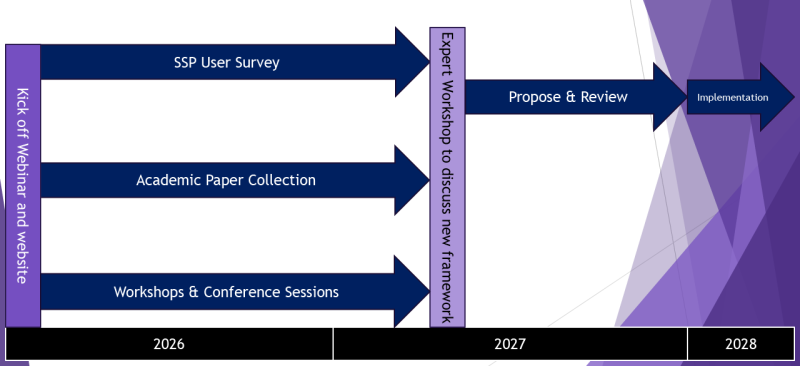
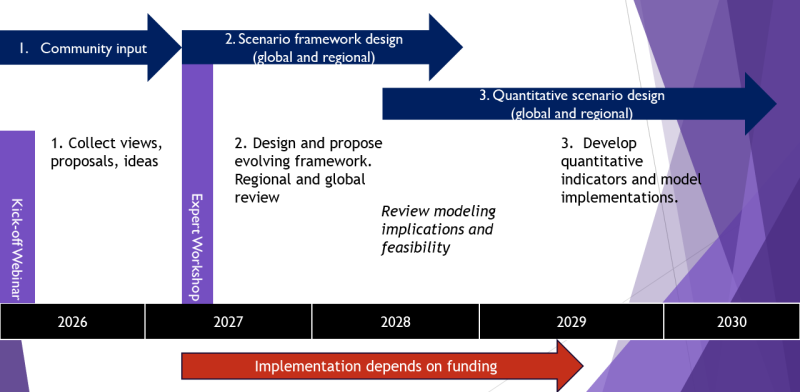
The multi-year process (2026–2030) includes information gathering, workshops, academic publications, and other approaches to reach consensus on the elements of the next generation of scenarios that would better support resilient, equitable, and sustainable development. The first and most critical step in this process is understanding your perspective. The current stage of SEP is focused on gathering the baseline data that will shape our strategic direction for 2026.
Get Involved
Please visit our survey page to learn more, or jump right in below!
Take the Survey
We are pleased to call for papers to our Special Issue on “Socioeconomic futures frameworks for motivating actions for sustainability” in the journal Futures. We are soliciting scholarly contributions that articulate constructive ideas and improvements for scenario development. The deadline for initial submission of full, review-ready drafts is January 3, 2027.
Call for Papers
News and Updates
-
30 June 2026 | Community Webinar Recording
Webinar recording: Link to recording / passcode: Tm880SS&
Recording of the Survey Stocktake and Community Webinar held on 30 June 2026.
This webinar presented a stocktake of the SEP survey based on data collected through 24 June, offering early insights into the geographical and sectoral distribution of responses received so far. Speakers shared preliminary findings and discussed gaps and biases in current participation, along with plans to broaden outreach as the survey continues through the end of 2026. The session also served as an opportunity for the international research community to ask questions and discuss ways to encourage wider engagement with the survey.
Visit our News & Updates page for previous news, events, and milestones from the Scenario Evolution Process (SEP).
Overview
Scenario Evolution Process (SEP) is a multi-year, community-driven initiative designed to understand how the Shared Socioeconomic Pathways (SSPs) were used andwhat the research community desires from future scenarios. This information will be used to chart a path for an appropriate evolution from the SSPs that goes beyond climate mitigation and adaptation to integrate nature, sustainable development, and social equity into the core of the future narratives.
SEP is envisaged as a re-evaluation of the architecture of the SSPs, guided by a community-based process. Through this global survey and upcoming workshops, the scientific community is asked to provide critical input on issues such as:
- What domains should future scenarios apply to?
- Should scenarios remain primarily exploratory ("what-if" thought experiments) or evolve into solution-oriented ("how-to") tools for resilience building?
- Should pathways remain static trajectories, or should we introduce "path-switching" to model how societies might pivot in response to crises? How?
- Should "wildcards," tipping points, and shocks (e.g., pandemics, conflicts) be included in narratives? How?
- Is it necessary to extend time horizons beyond 2100 to capture long-term earth system feedbacks?
Timeline
Information Collection Phase
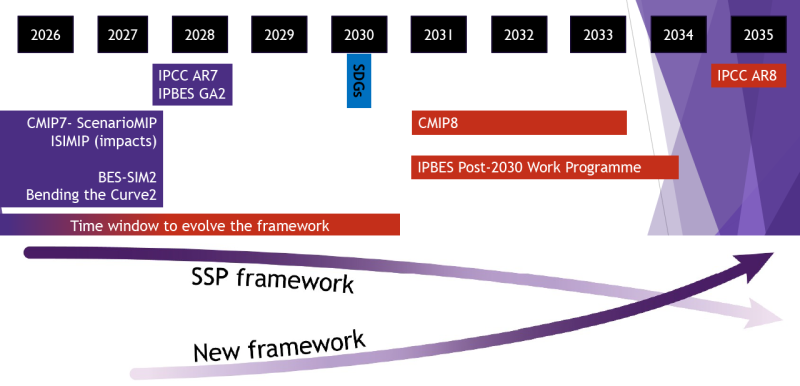
Overall Timeline for SEP
Timeline: The Big Picture
Who is Coordinating SEP?
The Scenario Evolution Process (SEP) is a community-wide initiative, coordinated by ICONICS (The International Committee on New Integrated Climate Change Assessment Scenarios) and led by the SEP Working Group.
The ICONICS Steering Committee
ICONICS serves as the primary coordinating body for the project. Leading experts from the Integrated Assessment Modeling (IAM) and Impacts, Adaptation, and Vulnerability (IAV), IPBES, and climate science communities ensure the scientific integrity and strategic continuity of the scenarios.
- Co-Chairs: Kristie Ebi (University of Washington), Bas van Ruijven (IIASA).
- Committee Members: Tim Carter, Edwin Castellanos, Katja Frieler, Matthias Garschagen, Stephane Hallegatte, Paula Harrison, Tomoko Hasegawa, Kasper Kok, Elmar Kriegler, Brian O'Neill, Keywan Riahi, Alex Ruane, Vanessa Schweizer, Nicholas Simpson, Anna Sörensson, Kiyoshi Takahashi, Detlef van Vuuren, and Anita Wreford.
- Support: Marina Andrijevic, Carole Green, Inga Menke, Jonathan Moyer
The SEP Working Group
- Co-Chairs: Jonathan Moyer (University of Denver), Vanessa Schweizer (University of Waterloo), Bas van Ruijven (IIASA)
- Working Group Members: Marina Andrijevic, Muhammad Awais, Crystal Drakes, Kristie Ebi, Carole Green, Inga Menke, Laura Pereira, Ethan Sullivan, Roberto Valdivia, Da Zhang
Commitment to Diversity
A core mandate of the SEP is to expand participation beyond the traditional research hubs. Working groups and consultations are structured to ensure representation from the Global South, gender balance, and early-career researchers, ensuring the next generation of scenarios reflects the diversity of the global community.
Submit a Nomination
ICONICS
The International Committee On New Integrated Climate change assessment Scenarios (ICONICS) develops, facilitates, and promotes the use of socioeconomic development pathways to support interdisciplinary research and assessment of climate change-related risks, and to support exploration of the effectiveness of adaptation and mitigation policies and actions across spatial and temporal scales to reduce those risks within the context of the Sustainable Development Goals.
ICONICS facilitates this mission through:
- Vertical integration: developing and applying integrative, cross-scale, and cross-sectoral scenarios;
- Horizontal integration: fostering interaction across scientific disciplines engaged in climate change research to develop, apply, and evaluate integrated scenarios bridging climate change, projected risks, adaptation, and mitigation; and
- Broadening the scope: promoting adaptation and mitigation research to support achieving the Sustainable Development Goals.
Learn More About ICONICS
Pardee
The Pardee Institute for International Futures, located at the University of Denver’s Josef Korbel School of International Studies, is a research center dedicated to analyzing long-term, global, human, and social systems to improve the human condition. It utilizes the International Futures (IFs) modeling system, which forecasts data for 188 countries up to 2100 to guide policy-making on development and sustainability.
Key Aspects of the Pardee Institute:
- Focus Areas: The institute focuses on forecasting, strategic analysis, and policy trade-offs regarding global changes in population, economics, health, and infrastructure.
- International Futures (IFs): This core, open-access, and integrated, modeling tool combines data, system dynamics, and human insight to explore potential, long-term scenarios.
Visit Pardee Institute
Support SEP
Realizing SEP’s vision requires coordination, inclusivity, and continuity. While the process is being launched by volunteer researchers across institutions and disciplines, it urgently needs support to sustain the technical and organizational backbone necessary for success:
- Coordination and facilitation: Enable the core team to manage the evolving, multi-stakeholder process and maintain transparency and momentum.
- Community engagement: Support a robust series of global and regional workshops, consultations, and co-development events, especially to ensure representation from underrepresented regions and disciplines.
- Travel and participation support: Ensure equitable participation of researchers and practitioners from across the Global South and low-income settings.
Partnership opportunities
We are seeking in-kind and financial support from partners committed to strengthening the foundations of global climate, biodiversity and development research. Contributions could include:
- Hosting or co-organizing workshops and coordination meetings
- Providing travel funds or participation grants
- Supporting part-time coordination and technical staff
The SEP offers funders a unique opportunity to help shape the infrastructure of future scenario-based research—fostering an open, inclusive, and globally relevant scientific foundation for decades to come.
For more information or to discuss partnership opportunities, please contact sep@du.edu.
History of Scenarios
The scientific modeling of the Earth’s future is an exercise in navigating uncertainty. Over the past five decades, the international research community developed increasingly sophisticated frameworks to couple the dynamics of human civilization—economics, demography, and governance—with physical Earth systems.
To understand where the Scenario Evolution Process (SEP) is going, we must first understand the frameworks that informedits creation.
-
1. Foundation
1970s-1980s
The conceptual bedrock of modern integrated assessment modeling (IAM) was laid in the early 1970s with the Club of Rome’s The Limits to Growth. Early models introduced the use of system dynamics to model global interactions between population, industrialization, and resources. The key insight from this era—which remains central to the SSPs today—was that the future is not a single linear forecast, but a fan of possibilities determined by policy choices and feedback loops.
-
2. Sequential Modeling
1990-2010
The need for standardized inputs for climate models became acute with the establishment of the Intergovernmental Panel on Climate Change (IPCC) in 1988. This led to the "Sequential Process," where socioeconomic narratives were developed to inform emissions estimates. The estimates were input into climate models.
- SA90 & IS92 (1990–1992): The first generation of IPCC scenarios provided essential data for early assessment reports but were often "flat," lacking deep narrative descriptions of the geopolitical or social worlds that produced the emissions.
- SRES Revolution (2000): The Special Report on Emissions Scenarios (SRES) marked a paradigm shift. For the first time, scenarios were organized around qualitative storylines ("families" like A1, B1) rather than just numbers. This highlighted that different socioeconomic choices could lead to similar emission outcomes but vastly different capacities to adapt.
-
3. Parallel Process & The SSPs
2010-2025
By the late 2000s, significant advances in science produced more information on the full range of greenhouse gas emissions at the same time that socioeconomic information in the SRES was becoming increasingly outdated.
To resolve this, the community adopted the Parallel Process that decoupled physical climate targets (Representative Concentration Pathways, or RCPs) from socioeconomic narratives (Shared Socioeconomic Pathways, or SSPs), facilitating multi-dimensional assessments of risk. Researchers could ask: “What does a 2°C world look like in the context of global cooperation (SSP1) versus regional rivalry (SSP3)?”. The resulting SSP-RCP Matrix became the standard for the IPCC AR5 and 6 and operational tools like the Network for Greening the Financial System (NGFS).
-
4. Next Evolution
2025-2030
The SSPs were designed primarily for climate-centric research. Today’s interconnected challenges—biodiversity loss, deep inequality, and the Sustainable Development Goals (SDGs)—may require a more holistic approach.
Current gaps identified by the community include:
- Artificial Baselines: The concept of "no-policy" worlds is increasingly unrealistic.
- The Equity Gap: Inequality and redistribution mechanisms are not explicitly modeled enough to answer "just transition" questions.
- Nature & Society: Scenarios are needed to integrate nature and human well-being, not just as inputs for climate, but as goals in themselves.
The Scenario Evolution Process is the community-led response to this mandate, moving from "Climate Scenarios" to "Holistic Socioeconomic Scenarios" for the AR7 cycle and beyond.