



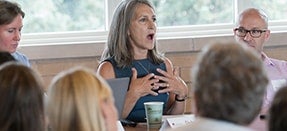



Building Resilient Scientists, One Webinar at a Time
Science isn’t easy. An upcoming webinar series hosted by DU’s 4D Experience teaches attendees how to face setbacks, criticism, and disagreements head on.

Starting a new job or project can be both exciting and nerve-wracking, especially in competitive fields like health and science. You’re focusing on your goals and contributing to work that could help people or broaden your skills. But what if you make a mistake? What if your work goes unnoticed? And what if you disagree with your boss?
Handling challenging situations like these takes resilience, and it’s critical to develop skills around resilience early on. An upcoming webinar series hosted by DU’s 4D Experience, called The Resilient Scientist, helps students move forward with confidence.
“Our students have a hunger for skill-building and support around issues of resilience,” says Laura Perille, executive director of 4D Experience. “For our first-year undergraduate students, viewing challenging situations as an opportunity to grow and learn was the top skill that they said that they wanted to develop in our new student survey.”
The five-part webinar series is created and presented by Sharon Milgram, PhD, the former director of the Office of Intramural Training and Education at the National Institutes of Health. Milgram has been teaching resilience to scientists, academics, and health professionals since the COVID-19 pandemic, when all three fields saw spikes in burnout. A 2021 survey of scientists by the scholarly journal Nature found 42% of respondents sought help or wanted help for anxiety and depression tied to their jobs.
But even without the pressure of fighting a pandemic, Milgram says science isn’t easy.
“Life is hard, but science is unique in that it’s supposed to fail a lot,” says Milgram. “In science, probably 80% of what we do is in a notebook, in ideas that never come to fruition.”
Milgram’s series starts with lessons aimed at building a “foundation of well-being,” empowering students to question negative self-talk, advocate for themselves, and ponder the stories they tell about their abilities and experiences.
This “cognitive reframing” is important when work starts to feel personal, according to Kateri McRae, the senior scholar of resilience with 4D’s new Resilience Lab and psychology professor in the College of Arts, Humanities, and Social Sciences. McRae played a key role in bringing Milgram’s series to DU.
“[This series] grounds its lessons in the challenges that high-performing, highly ambitious students face when they experience obstacles for the first time,” McRae explains. “It uses specific examples, like, ‘This [research] is important to you, you’ve wanted to do this your whole life—and then your paper is rejected.’ That can feel like an attack on you and everything you’re proud of. There are things about scientific training that you can control, and things you can't. And on that continuum, the stories you tell yourself are way more under your control.”
At the same time, rejection and criticism are a part of life. Milgram says the resilient scientist can receive feedback without getting defensive. The second half of her series focuses on staying calm in the face of criticism, evaluating whether it rings true, and communicating feedback in an assertive but respectful manner.
“I think self-awareness more often leads to a solid foundation [of resilience] than confidence,” says Milgram. “But confidence certainly comes up a lot [in the series] too, and it is important.”
One of the benefits of DU's 4D Experience is that students are connected with multiple mentors to guide their academic, personal, and professional development. The final part of Milgram’s series is designed with students and faculty in mind, reminding them how to get the most out of their mentorships—and for students, how to one day become good mentors themselves.
“[Successful mentorships are] about understanding communication styles,” says Milgram. She notes it’s also important for mentors not to get too caught up in their mentee’s career decisions. “A mentor needs to know that it’s not about them. They shouldn’t be vested in the decision; they should be vested in the person. I care that my mentee makes the right choice, even if it’s the wrong one for me.”
How to register
The Resilient Scientist: Tools for Thriving in Academic and Research Environments will meet online on Zoom every Monday at 1 p.m. MT from March 30 to April 27. The series is free, and although it is specifically designed for those in the STEM fields, everyone is welcome—including students, faculty, staff, and members of the broader community. It is highly recommended participants attend the series in full, but you can choose from the individual sessions below:
- March 30: Resilience and Well-Being: The Real Survival Skills
- April 6: Mind Games: Imposter Fears and Other Unhelpful Stories We Tell
- April 13: Assertiveness 2.0: Speaking Up, Even When Power Dynamics Are Hard
- April 20: Feedback: We Need It, Even When We Don’t Like It
- April 27: You Can’t Sing a Duet Alone: Mentoring Relationships for Success
You can register for the series here.


