





Introducing the AY26-27 4D Faculty Teaching Fellows
Launched in 2025 with the support of a grant from the national LearningWell Coalition, the 4D Faculty Teaching Fellows serve as activators and ambassadors who work to advance transformative, inclusive, and impactful teaching practices that not only support faculty across lines in their respective colleges/schools but also holistic student development in line with the 4D Experience. This work is designed to put the goals of DU colleges/schools into conversation with one another as well as university-wide initiatives to ensure that faculty have the strategies and tools they need to provide all students with the opportunity to grow holistically as learners.
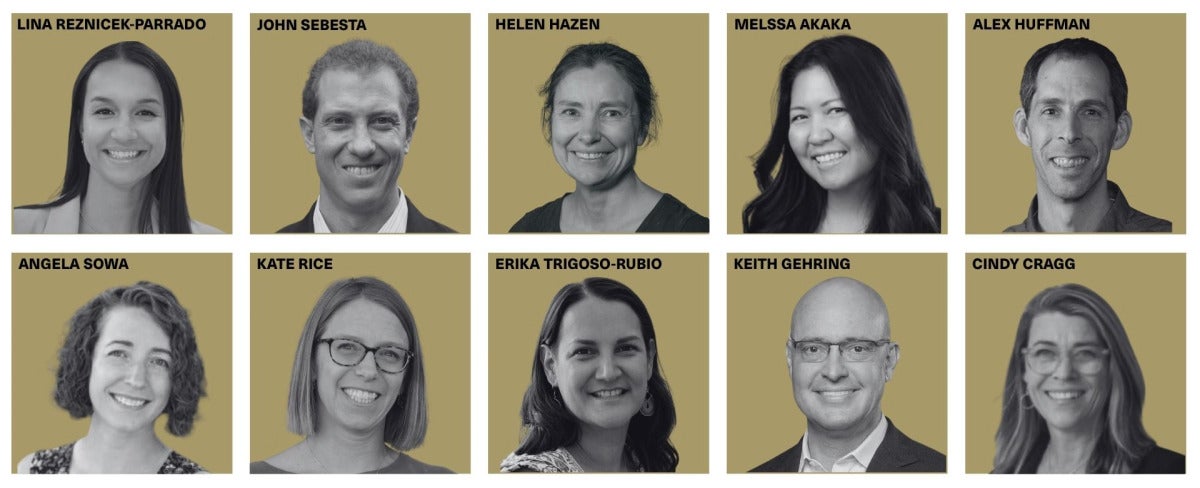
In this year’s cohort we have 10 faculty representing CAHSS, Daniels, Korbel, NSM, PSC, and the University Writing Program. Below they share what animates them in becoming a 4D Faculty Teaching Fellow:
ALEX HUFFMAN, Associate Professor of Chemistry and Biochemistry, NSM
The academic ecosystem and college in which I am embedded provides frequent opportunities to interact with students through a mix of field work, lab research, and classroom teaching. In many ways, the work I do to mentor students through graduate and undergraduate research has always been driven by the same broader motivations that developed into the DU 4D Experience. I help deepen intellect through refining students’ understanding of details and implications of experimental results. I help define students’ character and develop their well-being through the time we spend together and the process of forming deep relationships where we can discuss challenges and victories well outside the normal scope of the traditional research project boundaries. As a natural extension of that relationship, I help students open the horizon of their vision to new professional pathways where they can connect their disciplinary experience with their deeper values and passions. My engagement with NSM students on the south side of Iliff has often felt disjointed from efforts in the broader campus community, however. Serving as a 4D Faculty Teaching Fellow will help me connect with the vision and the experiences in the wider stream that the full university system represents. Undergraduate research experiences in NSM offer such rich opportunities to fully reflect the 4D vision, and the fellowship offers me the chance to learn about best practices that are already working elsewhere, to build strategic vision for my own educational context, and to share some of the ideas that already contribute to the 4D experiences in my group and college.
ANGELA SOWA, Teaching Professor, University Writing Program
The University Writing Program (UWP) is well positioned to contribute to the University's 4D Experience because writing instruction naturally supports intellectual inquiry, reflection, communication, and students' ability to connect learning across contexts. In addition, UWP faculty see first-year students across the year, with many faculty teaching common curriculum courses, including FSEM in fall, winter, and spring. This makes UWP faculty uniquely suited to both introducing 4D principles to students and being able to sustain that development across the first-year experience. Across the program, faculty already cultivate many elements of the 4D framework through writing-intensive, discussion-based, and reflective pedagogies. The greatest opportunity lies in helping faculty recognize where they are already advancing the four dimensions and providing shared tools and language that make those connections more intentional and visible to students. I see the Teaching Fellow role as an opportunity to connect institutional priorities with faculty expertise, helping colleagues recognize that many of the goals of the 4D Experience are already present in their teaching while providing practical strategies to strengthen and assess that work through the lens of accessibility.
Already I have been exploring ways in which I can make 4D principles more visible in my classroom. I would like to complement this broader work by exploring the nexus between accessibility and 4D in WRIT courses. The University Writing Program is well-suited to explore this nexus, as it has long been a leader in universal design and accessible teaching practices at DU. In addition, there is an appetite among faculty to continually improve their accessible practices, and the 4D framework provides a meaningful way to align pedagogical values and institutional vision.
CINDY CRAGG, Teaching Associate Professor and Faculty Director of Strategic Initiatives, College of Professional Studies
PSC is uniquely positioned to deliver a deeply integrated 4D Experience. Our student population, predominantly post-traditional working adults returning to school with varied professional and life experiences, arrives with an inherent readiness for the kind of reflective, purpose-driven learning the 4D framework cultivates. This year's expansion of the Student Success Course (SSC), one of several 4D initiatives I spearheaded during my 2025-2026 Faculty Teaching Fellowship, demonstrated that when our students are given structured prompts to articulate their values, connect them to academic goals, and situate their return to school within a larger sense of purpose, they engage with striking depth and authenticity. The launch of PSC's Riipen experiential learning pilot, a second initiative I shepherded into action during my fellowship, further demonstrated that real-world, industry-partnered projects produce exactly the kind of holistic growth in communication, collaboration, professional identity, and adaptability that 4D is designed to develop. The primary opportunity for growth lies in ensuring that the faculty (instructors and coaches) who guide students through these experiences are themselves fluent in 4D language and intentional about making those connections explicit. As PSC scales its Professional Passport program, which includes both experiential learning and the PSC Coaching Lab, there is a significant and time-sensitive opportunity to build 4D awareness and practice into the foundation of that growth.
ERIKA TRIGOSO-RUBIO, Teaching Associate Professor of Geography and the Environment, NSM
Several departments at DU offer the opportunity of field-based classes open to all DU majors. The department of Geography and the Environment is one of the most active in that regard, and involved faculty have collaborated extensively with colleagues across campus. As a 4D Faculty Teaching Fellow I would like to advance these initiatives, which are based on deep field knowledge and foster transformative, inclusive, and impactful teaching/learning. I will continue developing collaborations with faculty in different departments, advise and share experiences with faculty who will be planning their own classes, and share resources that I have created and that have been used across campus.
I will continue collaborating with like-minded faculty at NSM/RSECS and beyond and pursuing measurements to tie the impact of experiential learning on long-term personal growth.
HELEN HAZEN, Teaching Professor of Geography and the Environment, NSM
The study of geography and environmental studies naturally encourages the integration of the 4D dimensions, given the discipline’s focus around issues such as sustainability, well-being, and systems thinking. Most students come to the department with a passion not only for the study of geography but also with a social and environmental mission to study a subject with clear purpose. I think there is huge potential to more explicitly define how we develop these skills in students and how there is significant interaction among the different dimensions. My goal is to nurture these ideals among students within the geography community, as well as to develop connections with faculty both within Geography and across other NSM departments to encourage more explicit engagement with the 4D dimensions, which are already often incorporated into the curriculum.
JOHN SEBESTA, Director of Entrepreneurship@DU, Koch Endowed Chair of Entrepreneurship; Assistant Professor of the Practice, Daniels
The Daniels College of Business has a long history of supporting students across the Four Dimensions, yet we don’t always discuss it in that way. We have significant strengths in experiential learning and challenge-based education as students engage with real-world problems. I believe that our greatest opportunity centers on enhancing how we nurture students in the process of designing careers and lives of purpose. As a private university dedicated to the public good, that should be at our core, and it provides my primary motivation for becoming a professor.
I naturally bring the Four Dimensions into my courses and exchanges with students. Doing so enhances students' ability to make the connection between what they hear in orientation and what they experience as students throughout their journey. My goal is to further promote this process and find low friction opportunities to showcase the many connections which already exist. I believe that enhancing our ability to support students holistically is not only essential to distinguish the university from our peers but is essential to fulfilling our mission and promise to students. I am eager to learn from the cohort of faculty fellows and work collaboratively to support this mission.
KATE RICE, Teaching Assistant Professor of French, Center for World Languages and Cultures, CAHSS
I firmly believe that the work of CAHSS, pedagogically, academically and administratively, is rooted in the 4D Experience. This college does tremendous work to offer students a truly holistic experience that engages all four dimensions; from daily instruction to experiential opportunities, CAHSS faculty embrace relationship-rich practices that center critical reflection, student growth, intellectual curiosity and career connections. This alignment, when explicitly identified, named, and embraced, is a tremendous asset to our college, and therein lies the challenge. My experience this year has shown me that the greatest area for growth in CAHSS is understanding that the four dimensions are the articulation of core elements of who we are, what we believe, and what we practice as a college.
My role as a 4D Faculty Teaching Fellow has allowed me to see how my individual work contributes to the larger vision of both my college and the University of Denver. This role has helped me find a sense of belonging, alignment and purpose both within and beyond my teaching. It has given me the great opportunity to build relationships with colleagues across campus and to understand the ways that 4D activation and infusion enhances both the student and faculty experience in the CWLC/FYLP. I am grateful that this experience has modeled the power of a holistic approach to growth – it has truly been a 4D Experience for me both professionally and personally.
KEITH GEHRING, Teaching Associate Professor and Director of Undergraduate International Studies, Korbel
Korbel's undergraduate programs are, by definition, interdisciplinary and oriented toward the public good, preparing students for service in government, the not-for-profit sector, and private enterprise. Most students arrive already knowing why they came. What they don't always have is a clear line from that intention to the choices that actually build toward it: which second (or third) language, which second major, which study abroad destination, which scholarship to pursue. Without a more deliberate structure, students tend to choose from what's visible rather than what might best serve where they're headed. The opportunity is to better integrate and sequence what exists in partnership with faculty, so more students turn intention into execution while they’re still with us, not after they’ve graduated. My objective is to buttress the existing structure that helps students act on the choices already available to them, rather than defaulting to whatever's visible.
LINA REZNICEK-PARRADO, Teaching Associate Professor and Director of Spanish Program for Heritage/Bilingual Speakers, Spanish Language, Literary and Cultural Studies, CAHSS
The Spanish program at DU, in similar ways that the CWLC (Center for World Languages and Cultures) does (as illustrated by my colleague Kate
Rice’s current work as 4D Fellow), offers a compelling example of how DU’s four dimensions can emerge organically from a field of study. Language learning is inherently ambiguous, and that ambiguity is precisely what makes it such a rich site for student development. In our case within Spanish, when students step outside the classroom to engage with the nuances of real-world communication—something entirely necessary as Spanish is vital to communities across Denver—they are deepening their intellect. When they build relationships with Spanish-speaking communities that are already woven into the fabric of our city and our lives, language study becomes a process of belonging—one that shapes character and fosters a critical awareness of linguistic diversity, identity, and social equity. And through the professional pathways we continue to cultivate, students discover how Spanish is not only a vital tool for their futures, but a lens through which they learn to relate meaningfully to others. In many ways, what we do in Spanish already enacts the four dimensions—the framework names what our practice has long lived. The opportunity before us, however, is one of cohesion. The 4D framework arrives at exactly the right moment – not to reinvent what we do, but to help us center it together as we rediscover our practice and envision our future.
MELISSA AKAKA, Associate Dean for Research and Strategic Initiatives // Co-Director, Consumer Insights and Business Innovation Center // Professor of Marketing, DCB
The Daniels College of Business has made significant progress in creating transformational learning experiences that extend beyond the classroom through the 4D Experience, experiential learning, industry partnerships, and faculty mentorship. Our strategic plan, Elevate 2035, reinforces these strengths by positioning transformational student experience, impactful research, bold innovation, and societal impact as interconnected priorities. One of our greatest opportunities is to more intentionally connect research with student development across all four dimensions of the 4D framework.
My experience teaching in the Executive PhD program, working with graduate programs, and leading CiBiC has reinforced my belief that research is not simply an academic activity—it is a powerful form of experiential learning that helps students deepen their intellect, strengthen their character, build confidence and resilience, and discover purpose through meaningful engagement with real-world challenges. My objective as a 4D Faculty Teaching Fellow is to build a college-wide infrastructure that increases awareness, participation, and assessment of student engagement in research and helps research become a visible component of the Daniels student experience.