







Lamont’s Remy Le Boeuf Wins Grammy for Best Instrumental Composition
The six-time nominee and director of Jazz & Commercial Music Studies at the University of Denver won his first Grammy for the composition “First Snow.”
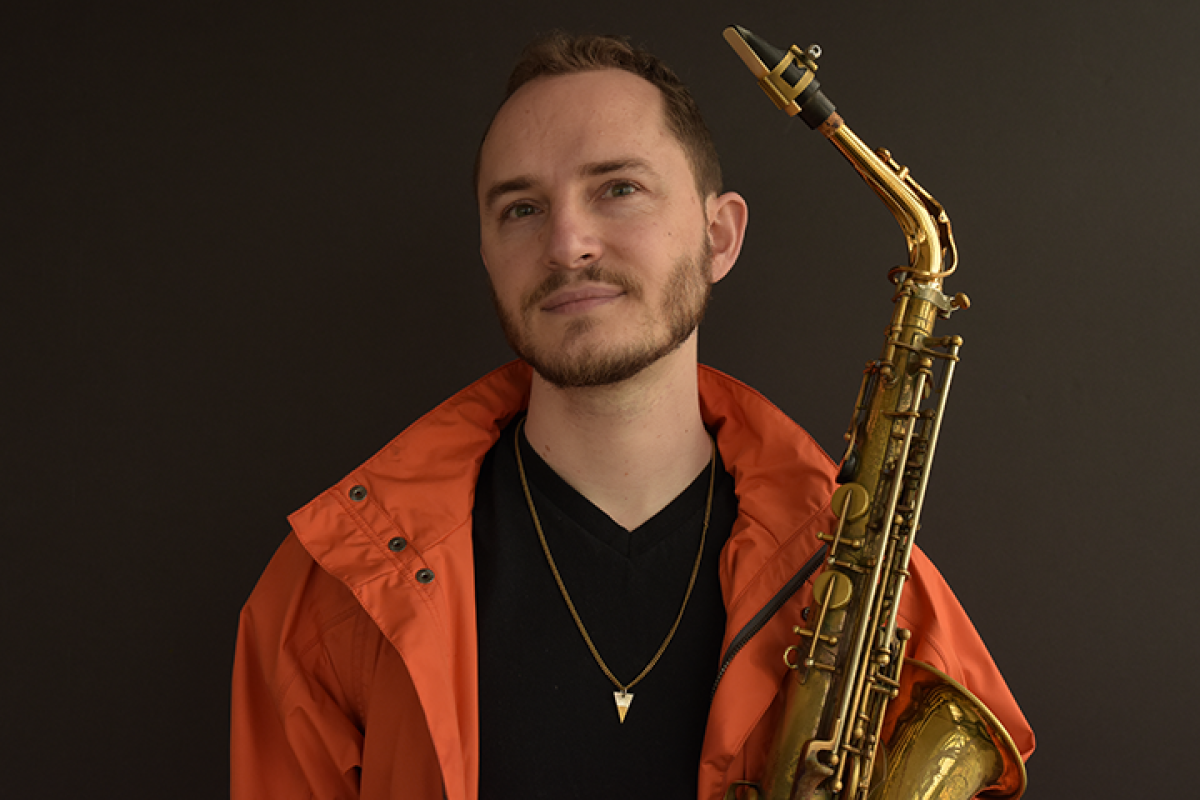
Modern jazz composer Remy Le Boeuf, director of Jazz & Commercial Music Studies in the Lamont School of Music at DU, took home his first Grammy Award on Feb. 1 for Best Instrumental Composition for his piece “First Snow.” The composition appears on “Silent Course,” his album with the Nordkraft Big Band, a Danish ensemble, and vocalist Danielle Wertz.
Following the win, Le Boeuf—who grew up making music alongside his twin brother and co-leads the jazz quintet Le Boeuf Brothers—shouted out his sibling’s recent success. “I want to shout out my twin brother, who won his first Grammy last year in the same category. Pascal, we're even now,” he said. (Pianist Pascal Le Boeuf earned the award in 2025 for “Strands.”)
He closed his acceptance speech by saying that his music is about building bridges between genres, countries, and musicians and listeners, and then added, “Let's keep building bridges.” You can watch Le Boeuf's full acceptance speech here.
The DU Newsroom first spoke with Remy Le Boeuf in 2023, shortly after he joined the Lamont faculty and received Grammy nominations for his album “Architecture of Storms” and the composition “Minnesota, WI.” That story appears below.
Lamont’s Remy Le Boeuf Scores Multiple Grammy Nominations
As a saxophonist, composer, and the Lamont School of Music’s new director of Jazz & Commercial Music Studies, Remy Le Boeuf has always had “big ideas” about music—ideas that have led to a successful career as a jazz innovator and, most recently, as composer and arranger of two Grammy-nominated albums.
In mid-November, his album, “Architecture of Storms,” was nominated for Best Large Jazz Ensemble Album, and his arrangement of the song “Minnesota, WI” for indie rock musician Bon Iver garnered a second nomination in the category of Best Arrangement, Instrumental or A Cappella.
Called a “big record” in terms of ambition, scale, and degree of difficulty, “Architecture of Storms” is the second album Le Boeuf has produced with his 20-plus-person jazz orchestra. His 2019 debut album, “Assembly of Shadows,” earned Grammy nominations for Best Instrumental Composition and Best Arrangement.
Le Boeuf’s music is rooted in traditional jazz but influenced by contemporary classical and indie rock. “Architecture of Storms” is a transitional album, demonstrating an indie rock-influence with his jazz orchestra. It’s “kind of like a bridge but also a continuation of the first album,” he says, noting that both record titles have the same initials and number of syllables. “I’m kind of finishing the first statement and opening the door to where I plan on going.”
Before coming to Denver in August, Le Boeuf spent 18 years in New York, where he attended the Manhattan School of Music and began his professional career. He has worked with a wide range of collaborators, including the Jazz at Lincoln Center Orchestra with Wynton Marsalis, Linda Oh, HAIM, JACK Quartet, Dayna Stephens, Prefuse 73, and his twin brother Pascal, with whom he co-leads the experimental jazz quintet, Le Boeuf Brothers.
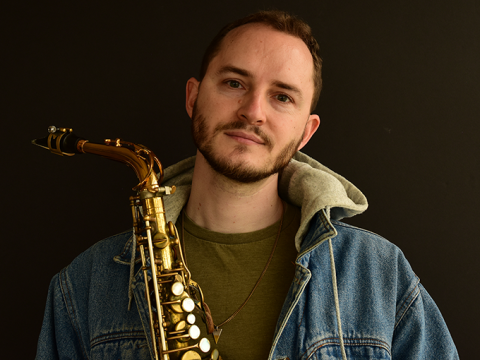
Growing up in Santa Cruz, California, Le Boeuf started playing the oboe when he was 10 and picked up the saxophone a year later. The first jazz album that became an obsession was Charles Mingus’ “Mingus Ah Um.” “I listened to pretty much nothing else for about a year,” he says. “I wanted to absorb it; I wanted to become that music. I wanted to listen to it as I slept and wake up being able to play everything on the saxophone—you know, some very childlike, innocent but kind of beautiful way of seeing the world.”
Not long after, he started using his sister’s old karaoke machine that had a tape recorder on it, and he would plan out epic orchestral compositions. “I never wrote them down or anything, but I had these big ideas in my head,” Le Boeuf recalls. “It wasn’t until many, many years later of trying to force really big, epic ideas into a small band that I realized, ‘Oh, I should just have a big band.’ So, when I put together my jazz orchestra, that’s when a lot of things clicked for me.”
Things also clicked when, around the time his second album was released, the position at Lamont opened up. He had previously worked with the Lamont faculty when he was commissioned to write a piece for the jazz orchestra a couple years earlier. “When I came for the interview process and met the students and faculty, I felt like it was a welcoming place, and it just felt like a wonderful community to become a part of,” he says.
In addition to conducting Lamont’s jazz orchestra and working with several advanced students on saxophone and composition, he has another album coming out in 2023 with Le Boeuf Brothers. He’s also working on a saxophone book and composing several commissions for different bands, including the Air Force Falconaires. In January, he began serving as chief conductor of the Nordkraft Big Band in Denmark.
The Grammy Awards are scheduled for Feb. 5 in Los Angeles. Le Boeuf plans to be on hand for the big event.
“Jazz music is not very in the spotlight for the general public, so to be a musician who gets nominated for a Grammy puts you in the public eye,” Le Boeuf says. “It puts your accomplishments in a lens where people can understand the significance [of your work], even if you operate in a smaller field like I do.”