






The Legacy of Sept. 11: A Professor’s Perspective
As the United States marks 25 years since the deadliest terror attack in history, DU professor and homeland security expert David Goldfischer talks about its lasting impacts on international security.
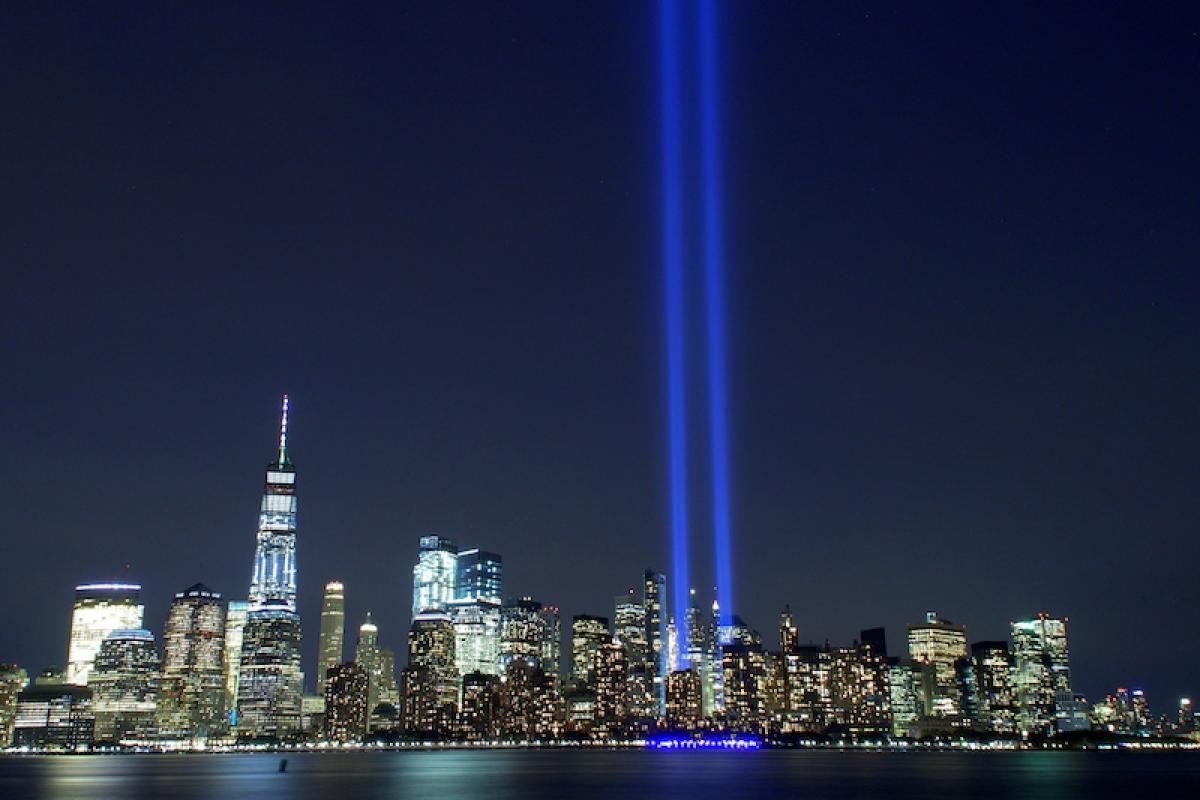
Today marks a quarter century since the terrorist attacks of Sept. 11, 2001, when four hijacked planes crashed into the World Trade Center in New York City, the Pentagon in Virginia, and a field in Pennsylvania, killing nearly 3,000 people and forever changing the country and the world in myriad ways.
On this solemn anniversary, the Newsroom asked David Goldfischer, associate professor in the University of Denver’s Josef Korbel School of Global and Public Affairs, to offer his perspective on the many impacts of the attacks and the U.S. response, as well as the changing nature of terrorism.
Goldfischer created the homeland security program at the Korbel School soon after 9/11. He also worked for several years with the United States Northern Command and at the National Defense University to help create and disseminate homeland security educational programs nationwide. From 2010 to 2013, he served as founding director of the Institute for Civil and International Security at Khalifa University, the United Arab Emirates’ first think tank in international and homeland security.
When it comes to international security, what is the most enduring impact of the 9/11 attacks?
United States decisions made in the aftermath of 9/11 have had profound impacts on international security. The invasion of Afghanistan, whose Taliban rulers had hosted al-Qaeda leader Osama bin Laden, enabled educational and career opportunities for millions of Afghan women; they now pay the highest price for the 2021 U.S. withdrawal and return to Taliban rule. The 9/11 attack also sealed President George W. Bush’s decision to invade Iraq (which was not implicated in 9/11), where sectarian war and the U.S. withdrawal in 2011 left a power vacuum, boosting Iran’s regional influence and enabling the rise of ISIS. The hundreds of thousands who died in those two wars, including more than 8,000 U.S. and coalition troops, are part of the legacy of 9/11.
On the more positive side, the unrelenting war on terror—despite valid criticisms of associated human rights violations—has greatly weakened what long seemed an unstoppable wave of violent Islamist terrorism on a global scale.
How has the threat of terrorism evolved in the years since the attacks?
Islamist terrorism against Western and other targets persisted, including major attacks in Bali (2002), Madrid (2004), London (2005), and Paris (2015), as well as the 2013 Boston Marathon bombing and the 2016 mass shooting at an Orlando nightclub. The stunning creation of the ISIS caliphate in 2014, which occupied large swaths of Iraq and Syria, brought U.S. forces back to the Middle East, where it was finally dismantled in 2019 through a multinational, U.S.-led campaign—with particular support from Kurdish and Iranian ground forces.
Unfortunately, an anti-Muslim backlash in Europe—prompted both by Islamist terrorism and the massive influx of refugees from Middle Eastern and North African wars—fueled the rise of the radical right and an upsurge in terrorism by right-wing extremist groups. It is that terrorist threat, accompanied by a broader challenge by the far right to democratic governance, that is now a greater concern—for supporters of Western democracies—than Islamist terrorism.
Are new technologies changing the nature of terrorist threats?
Terrorists are as resourceful as states and ordinary criminal groups, and they have quickly exploited every available new technology. Terrorist groups in the Middle East and Africa now routinely use drones, for example, and terrorist organizations (like their profit-seeking criminal counterparts) use cryptocurrencies to launder money, conduct cyberattacks including ransomware operations, and are no doubt incorporating AI for a range of activities.
While perhaps not describable as a terrorist, the late Pakistani physicist A.Q. Khan organized covert sales of nuclear weapons technologies and weapons designs, helping the nuclear acquisition programs of Libya, North Korea, and Iran. We continue to live with the danger that such bad actors, including leaders of radical regimes, will one day enable terrorists to acquire weapons of mass destruction (biological, chemical, or nuclear).
What is one thing you hope the public would consider on the anniversary of the 9/11 attacks?
For all its horrors, the attacks on 9/11 created a moment of national unity that is now absent and sorely needed. The 25th anniversary of this great tragedy has stirred memories of that shared experience of grief. While one would hope that such a sense of common destiny would stem from sources other than a terrible attack from abroad, one can also hope that the American public will take the sentiments evoked by this sad anniversary to heart.