




Not Your Average Class: DU’s Coolest First-Year Seminars
Author(s)
Anna Filippova
Student Writer

From designing tabletop games to tackling sustainability and leadership through pop culture, FSEMs pair faculty passion with hands-on learning and built-in support for new students.
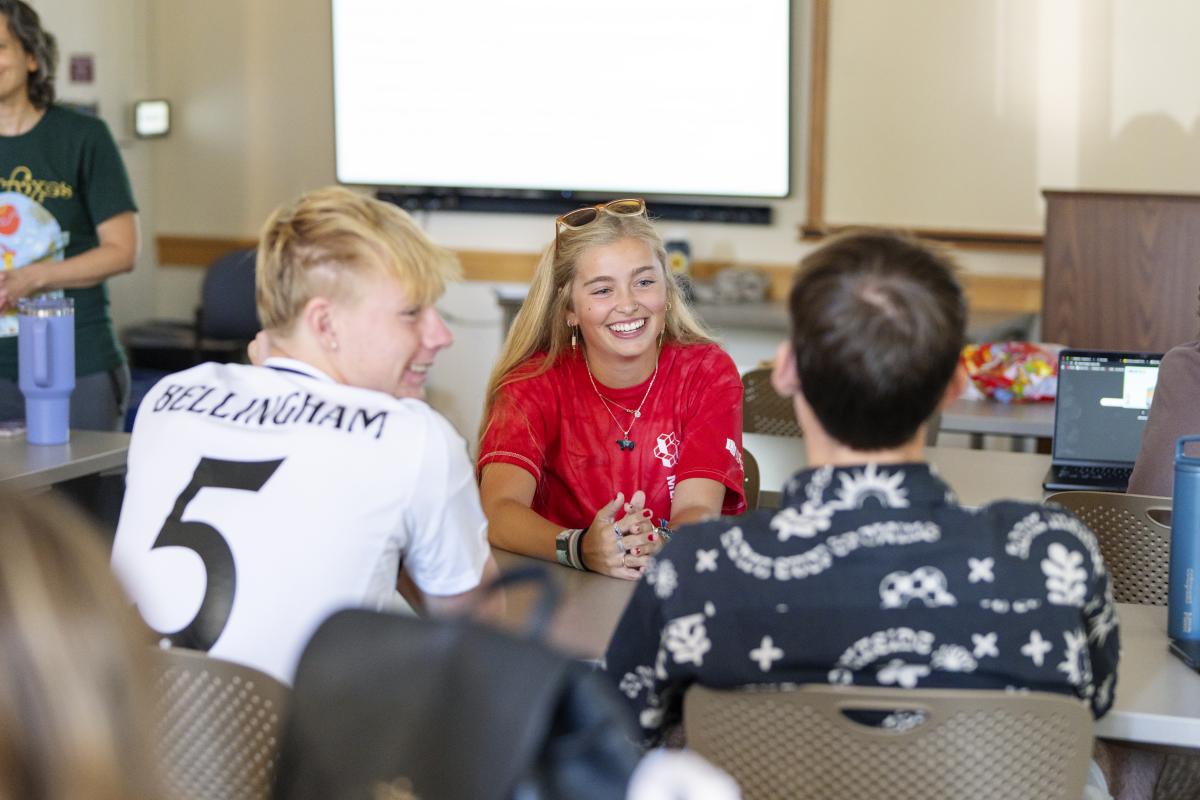
For many students, one of the most memorable parts of the DU experience is their First-Year Seminar. In these small, discussion-based courses, students have opportunities—such as traveling to the mountain campus, having lively debates, or meeting lifelong friends—that shape their first year here. With their combination of academic exploration and built-in community, it’s easy to see why FSEMs leave a lasting impression.
Required for all first-year students during the fall quarter, FSEMs also serve as students’ orientation groups, guided by 4D Peer Mentors and taught by DU faculty. These mentors and professors become trusted resources for first-year students.
FSEMs span a variety of disciplines and are often passion projects for the faculty who teach them. Students choose a seminar based on whatever genuinely interests them—whether it aligns with their major or is a subject they simply want to learn more about.
This past fall, students had 65 FSEMs to choose from; the full list is worth a look. Below are a few standouts that offered not just fun but also hands-on learning experiences. Look for the fall 2026 offerings later on this spring; incoming first-year students will register for their FSEMs during new-student registration in July.
Leadership Lessons the Richmond Way
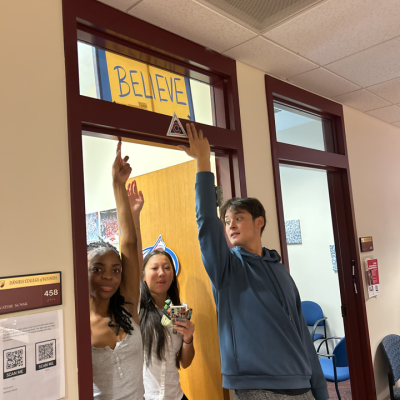
Inspired by “Ted Lasso,” the hit TV series about an American football coach hired to manage a British soccer team, this FSEM helped students design their leadership development journey at DU—through the lens of the 4D Experience and Lasso’s radically positive coaching philosophy, according to Kathleen Novak, teaching professor in the Daniels College of Business.
These intersections drew Koby Horowitz, a first year pursuing biology and film studies, to the course. “I felt that Ted Lasso was the perfect way to introduce the topic of optimism, where we, as future leaders, could ‘believe’ and have positive attributes in a sea of negativity,” he says.
Along with developing leadership competencies, students engaged in interactive activities, like visiting the Bell Tower and completing campus scavenger hunts, to immerse themselves in DU’s 4D approach to learning—focused on personal growth and character development, much like Ted Lasso’s approach to coaching.
Creating a New American State
Taught by Michael Greenberger, assistant professor of American politics, this course allowed students to do exactly what the title suggests: build their own state government. From writing a constitution to designing and participating in elections, students learned how government functions and how to engage in politics and policy in their own communities.
Students first explored the basics of government function, and then each took on the role of a state legislator, governor, or cabinet secretary in their newly created state. Through this simulation, students discovered the pros and cons of institutional designs and how they impact political outcomes and citizens' daily lives.
For Finn Caliento, a first-year majoring in international relations, this interactive component was the best part of the course. “Everyone being in character while engaging in the discussion was very fun as well as insightful as to how a legislative meeting would go,” he says. “Giving speeches, debating, and having a two-party rivalry helped me understand the material and engage with key concepts better.”
Greenberger says that kind of engagement is what inspired him to teach the course. “Constructive disagreement and genuine debate are increasingly absent from our public discourse, and I wanted to create a space where students could develop and practice these skills,” he says.
Seeing Through Clothes: Topics in Clothing/Dress/Costume/Fashion and Culture

Calling all fashionistas: This FSEM, taught by Janice Lacek, associate professor of theatre costume design and technology, focused on defining fashion and exploring its influence on culture and what it tells us about ourselves.
Grounded in fashion theory—ranging from fashion consumption in the 15th century to contemporary pop-culture trends observed in the media—the hands-on course concluded with an end-of-quarter “Trashion Show,” for which students were encouraged to let their creative juices flow and construct outfits from unconventional materials.
Trash and (Zero) Waste in a Disposable World
This course focused on something that is all around us but often invisible or ignored: trash. Taught by Megan Kelly, teaching professor in DU’s Writing Program, it helped students learn about consumption, waste, and the environmental and social effects of trash on communities.
“It’s exciting to work with students as they explore the stories that our trash tells us about who we are and how we relate to the world around us,” says Kelly.
Lucrezia Gowdy, a first-year majoring in biological sciences and Italian, appreciated the course for that very reason. “Although it might sound simple, I found it fascinating that we never think about the amount of trash we create because it disappears week after week,” she says.
Tabletop Games: Define and Design
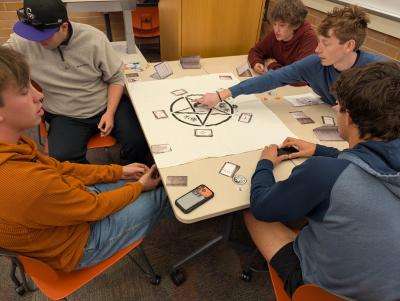
David Riche has always had a passion for tabletop games and the subculture surrounding them, and he got to share it with like-minded students in this playful FSEM.
Each student wrote their own design philosophy, created their own game, “playtested” it with their peers, and documented what they learned from the process, he explains. “Along the way, we talked about games as sources of joy, pieces of art, expressions of culture, and tools of persuasion,” he says.
Riche notes that this course goes beyond designing games and has a more meaningful takeaway: “Play is often characterized as being not serious. The reality is that play and games are cultural and psychological mirrors—dynamic systems through which we tell our stories, express our values, and exercise our vulnerabilities.”


