






Training the Mind—and Building a Business
At BASE Camp 2026, two DU alumni honed their entrepreneurial skills to grow their mental performance coaching practice.
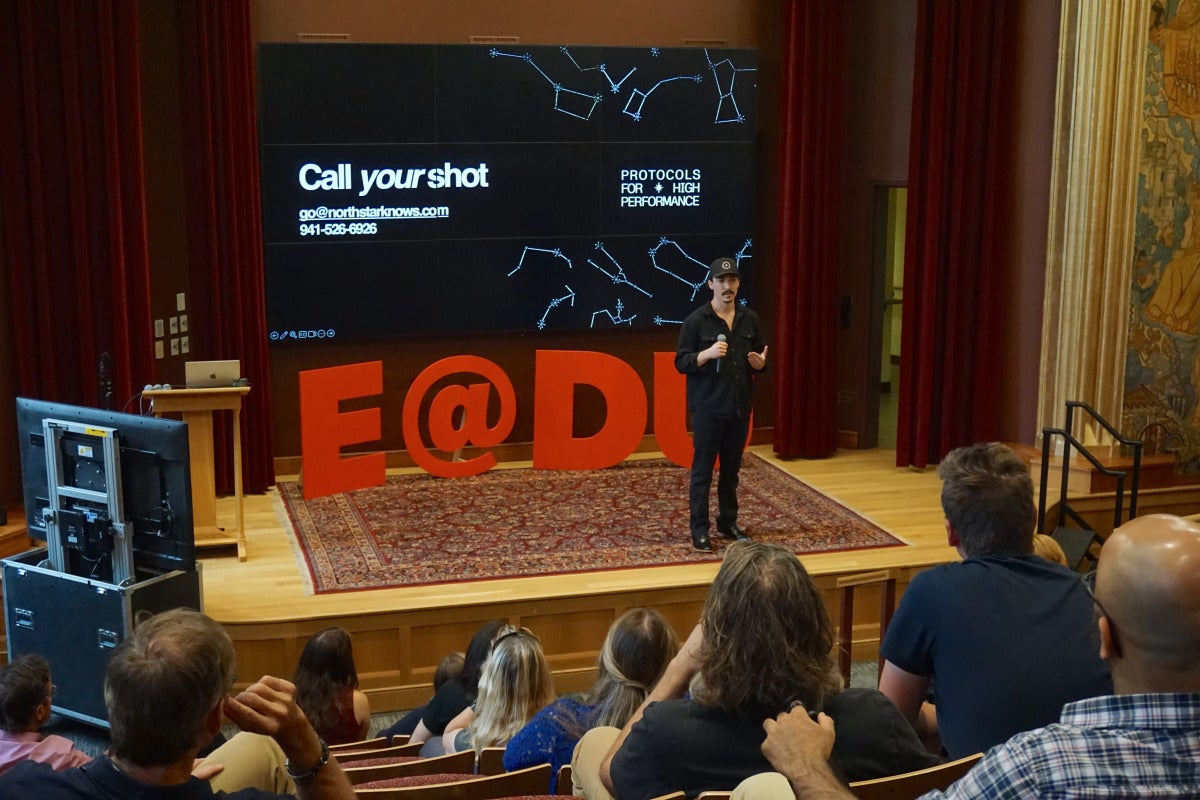
Sebastian Scalera (MA '25) presented the Northstar app at the final pitch in September.
Athletes train their bodies to perform at their best. But what happens when they need to train their minds?
This was the question that prompted Sebastian Scalera (MA ’25) and Sean Mahoney (MA ’23) to start their mental performance coaching business, Northstar. They met in the Sport and Performance Psychology program in DU’s Graduate School of Professional Psychology, where they both saw a need that the traditional approach wasn’t fulfilling.
“Our clients don't want to just talk about their thoughts and feelings. They want to take action,” says Scalera. “So we developed an approach that balances traditional reflection with mental skills training that is missing from the field of sport psychology. We also think it's missing from the world at large, and Northstar is putting it out there."
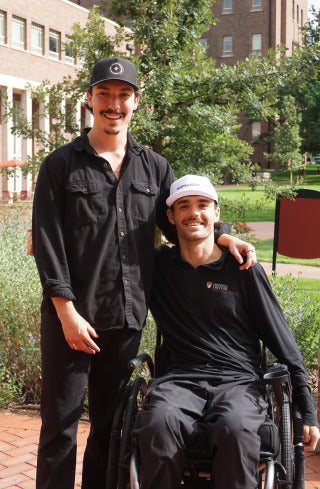
Their approach is based on psychological science but also on their own personal experiences navigating autoimmune disease and spinal cord injury. Mahoney, who was paralyzed in a boating accident at age 17, has done physical therapy for years but, in the process, realized his recovery required much more than that.
“After my injury, I had to rebuild my mindset, train my mind, and learn how to perform in all aspects of my life in a completely different way,” he says. “Those lessons became the foundation for how I now coach others.”
Two years ago, they started working with professional athletes in one-on-one sessions, helping them improve their confidence, focus, and composure. Soon, they were getting requests to go to practices and games, too. At that point, Scalera says, they had to figure out a way to help “even when we weren’t in the room.”
They came up with the idea of “sounds”—short, guided, audio coaching sessions that could be listened to on the field or just before stepping into the ring. They worked so well that they expanded them to “protocols,” sequences of sounds to help athletes get in the right mindset before, during, or even after performance.
Their client roster also expanded, as they realized their approach worked not only for athletes but also for other high-performing individuals, like touring musicians, executives, and first responders.
In an effort to continue growing their client base and make their system more accessible, Scalera and Mahoney developed an app, which they currently use with clients.
“Our idea now is to scale it so that we can help anybody anywhere perform the same way that pros do,” says Scalera—which is where the BASE Camp summer accelerator program came in.
A launchpad for growth
Every July and August, Entrepreneurship@DU hosts BASE Camp, a five-week intensive for startups that want to grow and accelerate their business. The program, which is open to all DU students and recent alumni, includes access to working spaces, workshops, mentors, networking, and one-to-one advising, plus a $5,000 stipend.
John Sebesta, director of Entrepreneurship@DU and the Koch Endowed Chair of Entrepreneurship, says there are three potential outcomes for BASE camp participants: They decide they have a great idea and are going to push it forward; they realize they’re close but need to make some adjustments; or they realize their idea is not the right opportunity and they need to step back.
“We consider all three to be successes,” says Sebesta. “Entrepreneurs are continuously finding and recognizing new opportunities. The challenge is knowing which ones to pursue and what the process is to pursue them. What they learn here they will apply to whatever opportunities lie ahead.”
BASE Camp participants explored everything from identifying and reaching their customers to creating a long-term product development cycle. They heard from and interacted with 30 industry leaders and visited alumni-owned businesses.
The group is quite small—this year, there were just eight participants. “We do that deliberately,” says Sebesta. “We want them to work really closely with their mentors and our faculty members, who are there day in and day out, processing the experience with them.”
For Scalera and Mahoney, all the work was well worth it. “We learned that we can’t just help people. We need help, too,” Scalera says.
In addition to getting constructive feedback on what worked well and what didn’t work well on their app, they learned the nuts and bolts of scaling their product—and are optimistic about the future of Northstar and how they can continue helping more people. Their immediate goal is to have 20,000 app users by the end of the year.
“We do this because it worked for us. We wouldn’t be here if it didn’t,” says Scalera. “For much of its history, psychology has focused on pathology, but the psychology of self-improvement is also real. We just want to get that out into the world.”