






First Fulbright Scholar-in-Residence Brings Global Perspective to DU
Johannes John-Langba will spend the 2026-27 academic year teaching, strengthening collaborations, and sharing global perspectives on mental health and social work.

When Johannes John-Langba arrived at the University of Denver in August, he brought with him extensive expertise in social work and global mental health—and the distinction of being DU’s first-ever Fulbright Scholar-in-Residence. He is one of just 29 scholars participating in the program during the 2026-27 academic year in the United States.
The appointment marks a milestone in DU’s international engagement and an opportunity to deepen its longstanding partnership with the University of KwaZulu-Natal (UKZN) in Durban, South Africa, where John-Langba is a professor of social work and director of the College of Humanities Doctoral Academy.
Throughout the academic year, he will teach graduate students, collaborate with faculty across disciplines, advance international research partnerships, and engage with community organizations.
“My primary goal is to help internationalize the DU campus—not just for faculty but for students as well—by teaching, mentoring, guest lecturing, and contributing to curriculum development on global mental health and policy, and by making my presence felt as DU’s first scholar-in-residence,” John-Langba says.
The Fulbright Scholar-in-Residence Program brings scholars from outside the U.S. to American colleges and universities for a semester or academic year, where they share their expertise with campus and local communities.
For Leasa Weimer, DU’s Fulbright liaison and director of internationalization, John-Langba’s appointment advances a relationship with the UKZN that has developed over more than a decade. The university is one of five DU strategic partners worldwide.
“It’s such an opportunity to have Johannes here for the full academic year,” Weimer says. “It strengthens our strategic partnership, enriches the exchange of knowledge and practice, and helps cultivate new collaborations while deepening existing ones."
A decade of connections
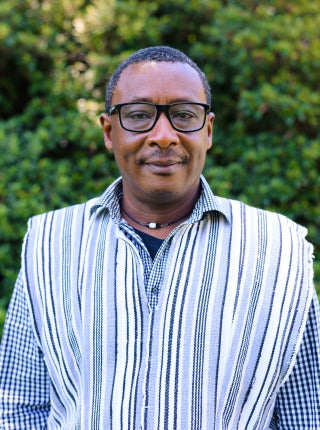
John-Langba’s relationship with DU began around 2014, when he was at the University of Cape Town. James Herbert Williams, then dean of DU’s Graduate School of Social Work, invited him to speak to a group of GSSW students visiting South Africa about the country and his experiences in the U.S. John-Langba continued meeting with visiting students over the next two years.
The connection led to further collaboration with DU faculty. In 2019, John-Langba and GSSW professor Lena Lundgren, who is now his primary faculty host, helped establish the Cross-National Inter-University Research Consortium, which brings together faculty from DU, UKZN, and two Swedish universities.
The consortium focuses on integrated care for people with complex physical health, behavioral health, and social service needs. Its work includes collaborative research, mentoring early-career researchers, and translating research findings into practice.
John-Langba’s appointment offers an opportunity to revive the consortium, which became less active after funding challenges, and pursue additional support for its work.
Bringing global mental health into the classroom—and beyond
John-Langba, who also serves as director at large for the World Federation for Mental Health and vice president of Cape Mental Health Society in South Africa, will teach graduate-level social work courses focused on global trauma and the ways policies that criminalize suicidal behavior can create barriers to accessing mental health services. He will also collaborate with the Graduate School of Professional Psychology, guest lecture in other disciplines, and participate in a colloquium through DU's Joint PhD Program in Religious Studies.
His goal is to bring international perspectives into teaching and curriculum development, encouraging faculty and students to consider different approaches to mental health and the provision of social services.
He also hopes to strengthen connections between DU and community organizations that host student interns. Drawing on his experience in both South Africa and the United States, he plans to explore the similarities and differences in how the two countries approach social services and mental health support.
Weimer sees opportunities for his expertise to inform work across DU.
“Mental health is a very timely topic in our society,” she says. “Johannes’ visit allows the DU community to learn more about global perspectives on mental health, including approaches and interventions—and consider how international best practices can inform our own research and practice."
Building lasting partnerships
John-Langba is already developing new collaborations. He and psychology professor Maria Vukovich have submitted a manuscript to the journal Trauma, Violence, & Abuse examining evidence for mental health and psychosocial support interventions in settings affected by fragility, conflict, and violence.
Another collaboration connects DU with doctoral students in South Africa. John-Langba invited Jonathan Moyer, director of the Pardee Institute at the Josef Korbel School of Global and Public Affairs, to present the institute’s International Futures model virtually to more than 100 students at the University of KwaZulu-Natal. Moyer also offered the students free access to online courses related to the model.
“For some of the students, it was the first time they’d heard about DU and the Pardee Institute,” John-Langba says. “That’s the beauty of this international collaboration and me being here. DU is known all over Africa now.”
John-Langba hopes his time at DU will lay the groundwork for continued exchange between the universities—and for future Fulbright Scholars-in-Residence at DU.
“If you ask me what my legacy is, it would be to see DU hosting a scholar-in-residence in successive years,” he says, “and for faculty, staff, and students to learn more about South Africa, the University of KwaZulu-Natal, and UKZN's vision to be the premier university of African scholarship.”