
Students Leave Guatemala Travel Class With New Perspective on Social Good
15 DU students spent spring break on an interterm trip that exposed them to a new culture and a new way of approaching business
By Amber D'Angelo
In a small home near Lake Atitlán, a Guatemalan woman tearfully described how she had fallen for a business scam that devastated her family. Around her, other female entrepreneurs listened intently. So did 15 University of Denver students and two Daniels College of Business faculty members—guests at the trust bank meeting for Friendship Bridge, a nonprofit that supports 37,000 Guatemalan women through business coaching and microfinancing.
That day’s meeting agenda included education about recognizing and avoiding common scams targeting small business owners. The DU group was there to see what “better business” looks like in practice—the sort of hands-on experience that comes from The Daniels Effect.
They traveled to Guatemala March 20-25, 2026, for the interterm travel class, Global Societal Impact and Social Entrepreneurship. Cross-listed between Entrepreneurship@DU and the Department of Business Ethics and Legal Studies (BELS), the course brought together undergrad and graduate students, some of whom were pursuing a joint graduate certificate in global business and corporate social responsibility at the Josef Korbel School of Global and Public Affairs.
“It was a really powerful, moving experience for all of us,” E@DU director John Sebesta said about the Friendship Bridge meeting. “Classroom learning became real-world impact. This course prepared students with knowledge, perspective, relationships and the confidence to operate in complex, real-world environments. It connected them to a broader community that extends far beyond campus. And it challenged them to think critically about the role they will play in shaping a more equitable and sustainable global economy.”
Before the trip, Sebesta and co-professor Bruce Klaw, BELS chair and assistant dean for societal impact, challenged the class to research strategies for Friendship Bridge to engage the next generation of donors and volunteers. They encouraged students to continually refine their recommendations into a polished, actionable client deliverable—requiring long hours of collaboration under tight deadlines, not unlike the realities of the business world.
“When we arrived in Guatemala, students didn’t just observe—they saw their work in action, sat in trust bank meetings, and engaged directly with the communities impacted,” Sebesta said. “That full arc—from classroom to field—transformed abstract concepts like ethical leadership and stakeholder impact into lived experience.”
Julia Frangul, a second-year graduate student studying international development at Korbel, found working alongside students from different backgrounds and areas of study “such good practice.”
“It was chaotic but worth the last-minute stress,” she said. “It felt amazing for the project to be useful to an organization. That never really happens—like, how many people actually read the papers you write? Maybe your professor.”
During the trip, students presented their report to CEO Tracie Cordeiro and her team, who are already implementing some of the ideas. The work was so impressive that Friendship Bridge is hiring one of the students as a youth engagement intern for the upcoming summer.
They also experienced Guatemala’s vibrant culture through curated visits with local businesses that challenged their beliefs about social impact and for-profit business.
Klaw said the goal was to connect students more directly with global markets and communities. “In-country immersion courses with a live client project are effective ways to bridge the gap between theory and practice,” he added. “This course challenged students to reimagine the relationship between business and society.”
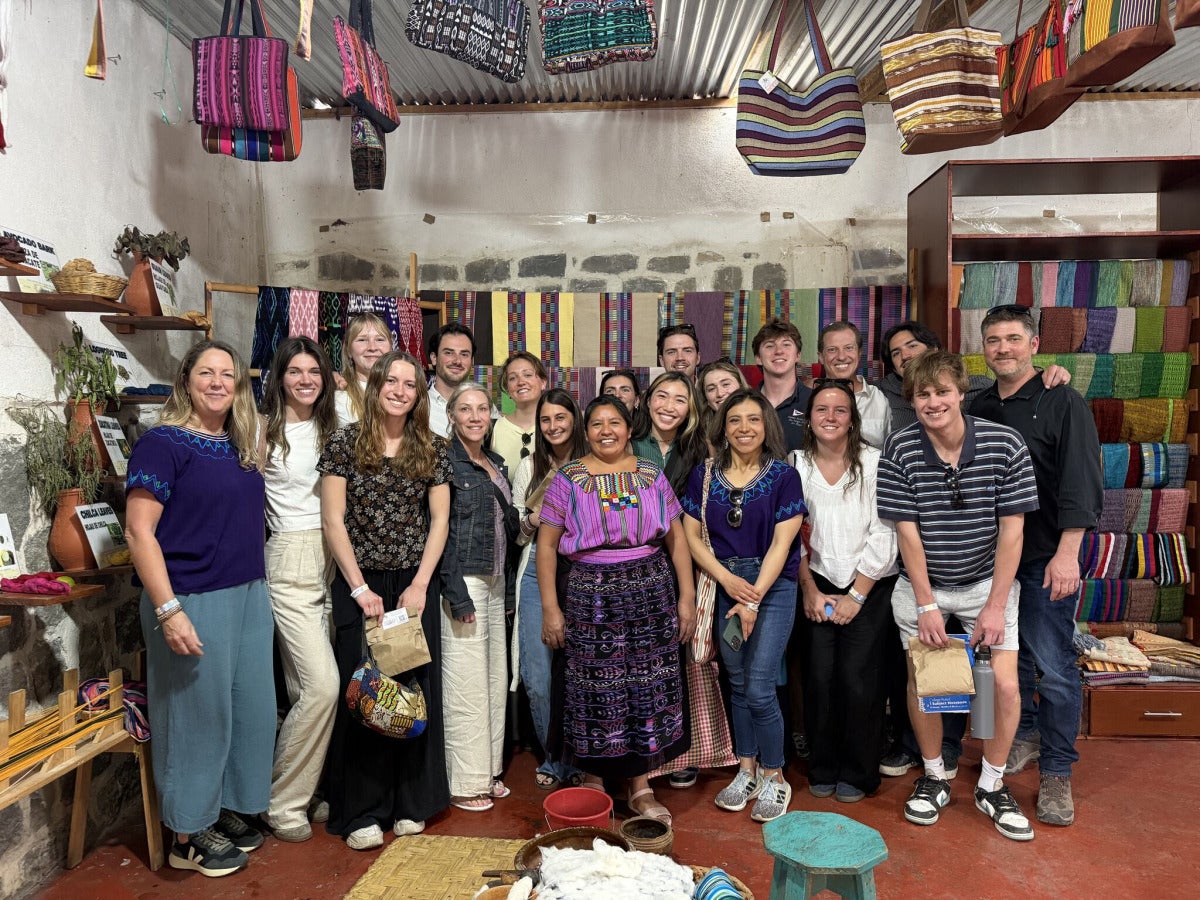
At a textile collective, students got to try their hand at traditional cotton weaving techniques while learning how women shared skills, resources and a supply chain, and collectively taught the next generation of textile workers at a small trade school next door—seeing the impact of Friendship Bridge firsthand, not just in a case study.
“It was really fun to sign up for something that included an experience where you got to get so much closer to people that come from such different places,” Frangul said.
Curiosity drew second-year undergraduate finance student and U.S. Marine Corps veteran Noah Hampton to the class.
“My goal in coming to Guatemala was studying entrepreneurship in small communities,” he said.
At a small, family-owned coffee plantation, business owners embraced the power of community to thrive together in the face of corporate competition.
“All of these families help each other, they all team up to share tips and help each other grow, versus saying, ‘Whoa, this is my business, it’s all about me,’” Hampton said.
Another visit helped reshape students’ assumptions about profit and purpose, showing that profitability and social impact are not mutually exclusive.
EcoFiltro, a water filter manufacturer, pivoted from a nonprofit to a for-profit business model based on internal feedback.
Sebesta explained that EcoFiltro’s decision to “develop higher-end water filter units that could be sold in urban markets to the wealthier and more affluent people of Guatemala” has allowed the company to maintain its rural water filter distribution program while drastically increasing access to clean water—from 2,000 filters a year to 10,000 each month.
“Instead of profit being something ‘evil’ that conflicts with or detracts from purpose, it was the tool that enabled them to really achieve the purpose more effectively,” Sebesta said. “It was just a really cool example of the power of using business and using profit as a tool for good.”
The trip opened Frangul’s eyes to a broader understanding of social impact.
“What really changed for me was my own perceptions on what is possible,” she said.
Her coursework in Korbel leans heavily on policy, nonprofit and governmental impact, but “this class was such an eye-opening experience to be able to see businesses and people making a profit doing something good,” she said.
“I’d always thought, ‘OK, you’re not going to make any money, you’re going to be working in the nonprofit sector’ but [Guatemalans] are doing something that genuinely makes them so happy, and it doesn’t have to be something that is making them no money either,” she added.
Hampton also noticed that Guatemalan employees are empowered with a unique voice to affect change.
“What was really working down there was learning and understanding the power of hearing your employees at every single level. That was one of the most powerful things that changed my mindset coming back,” he said.
That theme showed up consistently in the student reflection papers Sebesta read once the class ended.
“They saw firsthand that businesses can prioritize people, planet, and profit simultaneously—and that doing so is not theoretical, but operational,” he said. “This is the business of better business—and students aren’t just learning it. They’re living it.”
To hear additional reflections from students and faculty, listen to the latest E@DU podcast episode.